
A thin metallic spherical shell contains a charge +10 μC on it. A point charge +2 μC is placed at the centre of the shell and another charge +5 μC is placed outside it as shown. The force on the charge +2 μC at the centre is: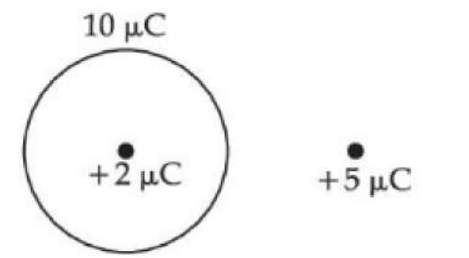
Zero
The charge +2 μC at the center of the metallic spherical shell induces an equal and opposite charge (-2 μC) on the inner surface of the shell. However, the shell itself has a net charge of +10 μC, which is distributed uniformly on the outer surface. Since the shell is conducting and spherical, it produces no electric field inside, meaning the charge +2 μC experiences no force. Thus, the net force on the charge at the center is zero.
Important Questions from Electric Charges and Fields
When a slab of insulating material 4 mm thick is introduced between the plates of a parallel plate capacitor of separation 4 mm, it is found that the distance between the plates has to be increased by 3.2 mm to restore the capacity to its original value. The dielectric constant of the material is:
Match List - I with List - II.
List - I List - II (A) Electric Field (I) [LTA] (B) Electric Flux (II) [L2] (C) Electric Dipole Moment (III) [ML3T−3A−1] (D) Area Vector Element (IV) [MLT−3A−1] Choose the correct answer from the options given below:
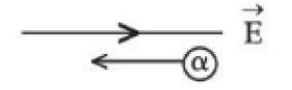
In the figure, an α-particle moves a distance l in a uniform electric field E as shown. Does the Electric Field do a positive or a negative work on the α-particle? Does the electric potential energy of the α-particle increase or decrease?
The force between two electric charges is expressed by the equation:
F = (k q1 q2) / r2
Which of the following is a correct statement?
Electrostatics deals with the study of forces, fields, and potential arising from static charges. Which of the following statements are correct?
- (A) Electrostatic force is a conservative force
- (B) Charge is quantized because only an integral number of electrons can be transferred from one body to the other
- (C) In a uniform electric field E, an electric dipole experiences a torque and a net force F
- (D) The electric field lines start from positive charges and end at negative charges. If there is a single charge, these may start or end at infinity.
Choose the correct answer from the options given below:


