
Match List - I with List - II. Choose the correct answer from the options given below:List - I List - II (A) Electric Field (I) [LTA] (B) Electric Flux (II) [L2] (C) Electric Dipole Moment (III) [ML3T−3A−1] (D) Area Vector Element (IV) [MLT−3A−1]
(A)-(IV), (B)-(III), (C)-(I), (D)-(II)
Understanding Dimensional Formulas in Physics
Dimensional analysis is a powerful tool in physics that helps us understand the relationship between different physical quantities. Every physical quantity can be expressed in terms of fundamental dimensions like Mass (M), Length (L), Time (T), and Electric Current (A). The question asks us to match specific quantities from electromagnetism with their correct dimensional formulas. Let's analyze each quantity provided in List I.
Analyzing Each Quantity's Dimension
We need to determine the dimensional formula for Electric Field, Electric Flux, Electric Dipole Moment, and Area Vector Element.
-
(A) Electric Field:
The electric field ($ \vec{E} $) is defined as the force experienced per unit charge. The formula is $ \vec{E} = \frac{\vec{F}}{q} $, where $ \vec{F} $ is the force and $ q $ is the charge.
The dimensional formula for Force is $ [\text{MLT}^{-2}] $. The dimensional formula for Charge is $ [\text{AT}] $ (since Current = Charge/Time, Charge = Current × Time).
So, the dimensional formula for Electric Field is:
\( [\text{E}] = \frac{[\text{F}]}{[\text{q}]} = \frac{[\text{MLT}^{-2}]}{[\text{AT}]} = [\text{MLT}^{-2}\text{A}^{-1}\text{T}^{-1}] = [\text{MLT}^{-3}\text{A}^{-1}] \)
This matches (IV) $ [\text{MLT}^{-3}\text{A}^{-1}] $ from List II.
-
(B) Electric Flux:
Electric flux ($ \Phi_E $) represents the total number of electric field lines passing through a given area. It is defined by the integral $ \Phi_E = \int \vec{E} \cdot d\vec{A} $.
The dimensional formula for Electric Field is $ [\text{MLT}^{-3}\text{A}^{-1}] $, as derived above. The dimensional formula for Area ($ d\vec{A} $) is $ [\text{L}^2] $.
So, the dimensional formula for Electric Flux is:
\( [\Phi_E] = [\text{E}] \times [\text{Area}] = [\text{MLT}^{-3}\text{A}^{-1}] \times [\text{L}^2] = [\text{ML}^{1+2}\text{T}^{-3}\text{A}^{-1}] = [\text{ML}^3\text{T}^{-3}\text{A}^{-1}] \)
This matches (III) $ [\text{ML}^3\text{T}^{-3}\text{A}^{-1}] $ from List II.
-
(C) Electric Dipole Moment:
An electric dipole moment ($ \vec{p} $) is defined as the product of the magnitude of one of the charges ($ q $) and the distance ($ d $) between the two charges forming the dipole. The formula is $ \vec{p} = q\vec{d} $.
The dimensional formula for Charge ($ q $) is $ [\text{AT}] $. The dimensional formula for distance ($ d $) is $ [\text{L}] $.
So, the dimensional formula for Electric Dipole Moment is:
\( [\text{p}] = [\text{q}] \times [\text{d}] = [\text{AT}] \times [\text{L}] = [\text{LTA}] \)
This matches (I) $ [\text{LTA}] $ from List II.
-
(D) Area Vector Element:
An area vector element ($ d\vec{A} $) represents an infinitesimal area. Area is a measure of the extent of a two-dimensional surface.
The dimensional formula for any Area is simply the square of the dimension of Length.
\( [\text{Area}] = [\text{L}]^2 = [\text{L}^2] \)
This matches (II) $ [\text{L}^2] $ from List II.
Summary of Matching
Based on the dimensional analysis, the correct matching is:
- (A) Electric Field matches with (IV) $ [\text{MLT}^{-3}\text{A}^{-1}] $.
- (B) Electric Flux matches with (III) $ [\text{ML}^3\text{T}^{-3}\text{A}^{-1}] $.
- (C) Electric Dipole Moment matches with (I) $ [\text{LTA}] $.
- (D) Area Vector Element matches with (II) $ [\text{L}^2] $.
Comparing this matching with the given options:
- Option 1: (A)-(IV), (B)-(III), (C)-(I), (D)-(II)
- Option 2: (A)-(IV), (B)-(II), (C)-(III), (D)-(I)
- Option 3: (A)-(III), (B)-(IV), (C)-(I), (D)-(II)
- Option 4: (A)-(II), (B)-(III), (C)-(I), (D)-(IV)
The correct option is the one that matches our derived pairings.
| List - I (Quantity) | Dimensional Formula | List - II Match |
|---|---|---|
| (A) Electric Field ($ \vec{E} $) | $ [\text{MLT}^{-3}\text{A}^{-1}] $ | (IV) |
| (B) Electric Flux ($ \Phi_E $) | $ [\text{ML}^3\text{T}^{-3}\text{A}^{-1}] $ | (III) |
| (C) Electric Dipole Moment ($ \vec{p} $) | $ [\text{LTA}] $ | (I) |
| (D) Area Vector Element ($ d\vec{A} $) | $ [\text{L}^2] $ | (II) |
The correct correspondence is (A)-(IV), (B)-(III), (C)-(I), (D)-(II).
Revision Table: Key Dimensions in Electromagnetism
| Quantity | Common Symbol | Derivation Basis | Dimensional Formula (M, L, T, A) |
|---|---|---|---|
| Charge | \( q \) | Current \( \times \) Time | \( [\text{AT}] \) |
| Electric Field | \( \vec{E} \) | Force / Charge | \( [\text{MLT}^{-3}\text{A}^{-1}] \) |
| Electric Flux | \( \Phi_E \) | Electric Field \( \times \) Area | \( [\text{ML}^3\text{T}^{-3}\text{A}^{-1}] \) |
| Electric Dipole Moment | \( \vec{p} \) | Charge \( \times \) Distance | \( [\text{LTA}] \) |
| Area | \( A \) | Length \( \times \) Length | \( [\text{L}^2] \) |
| Force | \( \vec{F} \) | Mass \( \times \) Acceleration | \( [\text{MLT}^{-2}] \) |
Additional Information: Importance of Dimensional Analysis
Dimensional analysis is crucial in physics for several reasons:
- Checking Consistency: It helps verify if an equation is dimensionally consistent. Both sides of an equation must have the same dimensions.
- Deriving Relationships: It can be used to derive relationships between physical quantities in some cases, especially when the dependence on fundamental quantities is simple.
- Unit Conversion: Understanding dimensions is fundamental to converting units from one system to another.
- Identifying Errors: If a calculation results in dimensions that don't match the expected quantity, it indicates an error in the process.
By expressing quantities in terms of fundamental dimensions, we can simplify problems and gain deeper insight into the physical nature of equations and concepts.
Important Questions from Electric Charges and Fields
Two charged particles, placed at a distance d apart in vacuum, exert a force F on each other. Now, each of the charges is doubled. To keep the force unchanged, the distance between the charges should be changed to:
When a slab of insulating material 4 mm thick is introduced between the plates of a parallel plate capacitor of separation 4 mm, it is found that the distance between the plates has to be increased by 3.2 mm to restore the capacity to its original value. The dielectric constant of the material is:
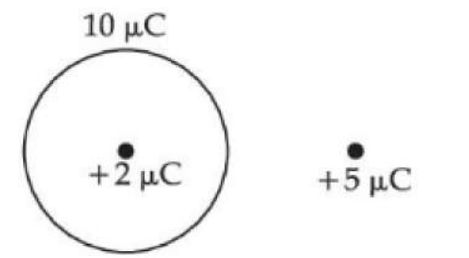
A thin metallic spherical shell contains a charge +10 μC on it. A point charge +2 μC is placed at the centre of the shell and another charge +5 μC is placed outside it as shown. The force on the charge +2 μC at the centre is:
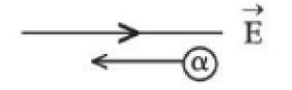
In the figure, an α-particle moves a distance l in a uniform electric field E as shown. Does the Electric Field do a positive or a negative work on the α-particle? Does the electric potential energy of the α-particle increase or decrease?
The force between two electric charges is expressed by the equation:
F = (k q1 q2) / r2
Which of the following is a correct statement?


