
When a slab of insulating material 4 mm thick is introduced between the plates of a parallel plate capacitor of separation 4 mm, it is found that the distance between the plates has to be increased by 3.2 mm to restore the capacity to its original value. The dielectric constant of the material is:
5
Understanding the Parallel Plate Capacitor with Dielectric
This problem involves analyzing how the capacitance of a parallel plate capacitor changes when a dielectric material is introduced between its plates and the plate separation is adjusted to restore the original capacitance. We need to find the dielectric constant of the material.
Initial Setup of the Parallel Plate Capacitor
Initially, we have a parallel plate capacitor with a plate separation of \(d_0 = 4\) mm. Let the area of each plate be \(A\). The capacitance of this capacitor in vacuum or air is given by the formula:
\[C_0 = \frac{\epsilon_0 A}{d_0}\]
Substituting the initial separation \(d_0 = 4\) mm:
\[C_0 = \frac{\epsilon_0 A}{4 \text{ mm}}\]
Introducing the Dielectric Slab and Adjusting Separation
A slab of insulating material (dielectric) with thickness \(t = 4\) mm is introduced between the plates. Initially, this slab would likely fill the entire gap. However, the problem states that after introducing the slab, the distance between the plates has to be increased by 3.2 mm to restore the capacity to its original value \(C_0\).
The new separation between the plates, let's call it \(d'\), is the original separation plus the increase:
\[d' = d_0 + 3.2 \text{ mm} = 4 \text{ mm} + 3.2 \text{ mm} = 7.2 \text{ mm}\]
Now, the capacitor has a gap of \(d' = 7.2\) mm, with a dielectric slab of thickness \(t = 4\) mm and dielectric constant \(K\) inside this gap. The remaining space in the gap is \(d' - t = 7.2 \text{ mm} - 4 \text{ mm} = 3.2 \text{ mm}\), which is assumed to be vacuum or air.
The capacitance of a parallel plate capacitor with a dielectric slab of thickness \(t\) placed between plates separated by distance \(d'\) is given by:
\[C' = \frac{\epsilon_0 A}{(d' - t) + \frac{t}{K}}\]
Substituting the values \(d' = 7.2\) mm and \(t = 4\) mm:
\[C' = \frac{\epsilon_0 A}{(7.2 \text{ mm} - 4 \text{ mm}) + \frac{4 \text{ mm}}{K}} = \frac{\epsilon_0 A}{3.2 \text{ mm} + \frac{4 \text{ mm}}{K}}\]
Restoring Capacitance to Original Value
According to the problem, the new capacitance \(C'\) is equal to the original capacitance \(C_0\). So, we set the expressions for \(C'\) and \(C_0\) equal to each other:
\[C' = C_0\]
\[\frac{\epsilon_0 A}{3.2 + \frac{4}{K}} = \frac{\epsilon_0 A}{4}\]
Since \(\epsilon_0 A\) is present on both sides and is non-zero, we can cancel it out:
\[\frac{1}{3.2 + \frac{4}{K}} = \frac{1}{4}\]
Taking the reciprocal of both sides:
\[3.2 + \frac{4}{K} = 4\]
Calculating the Dielectric Constant \(K\)
Now, we need to solve this equation for \(K\):
\[\frac{4}{K} = 4 - 3.2\]
\[\frac{4}{K} = 0.8\]
To find \(K\), we can rearrange the equation:
\[K = \frac{4}{0.8}\]
Multiplying the numerator and denominator by 10 to remove the decimal:
\[K = \frac{40}{8}\]
\[K = 5\]
The dielectric constant of the material is 5.
Summary of Steps
- Determine the initial capacitance \(C_0\) based on the initial plate separation.
- Calculate the new plate separation \(d'\) after increasing the distance.
- Write the expression for the new capacitance \(C'\) with the dielectric slab of thickness \(t\) in the gap \(d'\).
- Equate \(C'\) and \(C_0\) as the capacitance is restored.
- Solve the resulting equation for the dielectric constant \(K\).
| Parameter | Initial State | Final State (with Dielectric) |
|---|---|---|
| Plate Separation | \(d_0 = 4 \text{ mm}\) | \(d' = 7.2 \text{ mm}\) |
| Dielectric Slab Thickness | N/A | \(t = 4 \text{ mm}\) |
| Dielectric Constant | \(K = 1\) (Air/Vacuum) | \(K\) (unknown) |
| Capacitance | \(C_0\) | \(C' = C_0\) |
The calculated dielectric constant is 5.
Revision Table: Parallel Plate Capacitor Concepts
| Concept | Formula | Description |
|---|---|---|
| Capacitance (Vacuum/Air) | \(C = \frac{\epsilon_0 A}{d}\) | Capacitance is directly proportional to plate area \(A\) and inversely proportional to separation \(d\). \(\epsilon_0\) is permittivity of free space. |
| Dielectric Constant (Relative Permittivity) | \(K = \frac{\epsilon}{\epsilon_0}\) | Ratio of permittivity of material \(\epsilon\) to permittivity of free space \(\epsilon_0\). \(K \ge 1\). |
| Capacitance with Full Dielectric | \(C_d = KC_0 = K \frac{\epsilon_0 A}{d}\) | Capacitance increases by a factor of \(K\) when the gap is completely filled with a dielectric. |
| Capacitance with Partial Dielectric Slab | \(C = \frac{\epsilon_0 A}{(d - t) + \frac{t}{K}}\) | For a slab of thickness \(t\) in a gap \(d\), the effect is like reducing the effective separation to \(d - t + \frac{t}{K}\). |
Additional Information: Dielectric Materials and Capacitance
Dielectric materials are electrical insulators. When placed in an electric field, the molecules within the dielectric become polarized. This polarization creates an internal electric field that opposes the external field, reducing the net electric field within the dielectric.
- Introducing a dielectric material between the plates of a capacitor, while keeping the charge constant, reduces the electric field and thus the voltage (\(V = Ed\)). Since capacitance is \(C = Q/V\), a reduced voltage for the same charge means the capacitance increases.
- If the voltage source is kept constant, introducing a dielectric increases the charge stored on the plates (\(Q = CV\)), again indicating an increase in capacitance.
- The dielectric constant \(K\) quantifies how much a material increases the capacitance compared to vacuum. A higher \(K\) means the material is better at reducing the electric field and increasing capacitance. \(K=1\) for vacuum (and approximately for air). For other materials, \(K > 1\).
- In the formula \(C = \frac{\epsilon_0 A}{(d - t) + \frac{t}{K}}\), the term \((d - t)\) represents the effective thickness of the air/vacuum gap, and \(\frac{t}{K}\) represents the effective thickness of the dielectric slab in terms of equivalent air gap. The sum is the total effective separation.
Important Questions from Electric Charges and Fields
Two charged particles, placed at a distance d apart in vacuum, exert a force F on each other. Now, each of the charges is doubled. To keep the force unchanged, the distance between the charges should be changed to:
Match List - I with List - II.
List - I List - II (A) Electric Field (I) [LTA] (B) Electric Flux (II) [L2] (C) Electric Dipole Moment (III) [ML3T−3A−1] (D) Area Vector Element (IV) [MLT−3A−1] Choose the correct answer from the options given below:
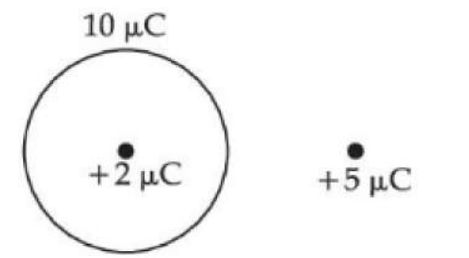
A thin metallic spherical shell contains a charge +10 μC on it. A point charge +2 μC is placed at the centre of the shell and another charge +5 μC is placed outside it as shown. The force on the charge +2 μC at the centre is:
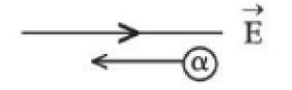
In the figure, an α-particle moves a distance l in a uniform electric field E as shown. Does the Electric Field do a positive or a negative work on the α-particle? Does the electric potential energy of the α-particle increase or decrease?
The force between two electric charges is expressed by the equation:
F = (k q1 q2) / r2
Which of the following is a correct statement?


