
Two charged particles, placed at a distance d apart in vacuum, exert a force F on each other. Now, each of the charges is doubled. To keep the force unchanged, the distance between the charges should be changed to:
2d
Understanding Force Between Charged Particles
This problem deals with the electrostatic force between two point charges, which is described by Coulomb's Law. Coulomb's Law states that the force between two point charges is directly proportional to the product of the magnitudes of the charges and inversely proportional to the square of the distance between them.
The formula for the electrostatic force \(F\) between two charges \(q_1\) and \(q_2\) separated by a distance \(r\) in a vacuum is given by:
\[ F = k \frac{|q_1 q_2|}{r^2} \]where \(k\) is Coulomb's constant.
Analyzing the Initial Situation
Initially, we have two charged particles with charges \(q_1\) and \(q_2\) placed at a distance \(d\) apart in a vacuum. The force between them is given as \(F\). Using Coulomb's Law, we can write the initial force as:
\[ F = k \frac{|q_1 q_2|}{d^2} \quad (1) \]Analyzing the Changed Situation
Now, each of the charges is doubled. The new charges are \(q_1' = 2q_1\) and \(q_2' = 2q_2\). We want to find the new distance, let's call it \(d'\), such that the force between the charges remains unchanged, i.e., the new force \(F'\) is equal to the initial force \(F\).
The new force \(F'\) between the new charges \(q_1'\) and \(q_2'\) at the new distance \(d'\) is:
\[ F' = k \frac{|q_1' q_2'|}{(d')^2} \]Substitute the new charge values \(q_1' = 2q_1\) and \(q_2' = 2q_2\):
\[ F' = k \frac{|(2q_1) (2q_2)|}{(d')^2} \] \[ F' = k \frac{|4 q_1 q_2|}{(d')^2} \] \[ F' = 4 k \frac{|q_1 q_2|}{(d')^2} \quad (2) \]Keeping the Force Unchanged
The problem states that the force remains unchanged, which means \(F' = F\). We can now equate the expressions for \(F\) from equation (1) and \(F'\) from equation (2):
\[ k \frac{|q_1 q_2|}{d^2} = 4 k \frac{|q_1 q_2|}{(d')^2} \]We can cancel out the common terms \(k\) and \(|q_1 q_2|\) from both sides (assuming the charges are non-zero):
\[ \frac{1}{d^2} = \frac{4}{(d')^2} \]Now, we need to solve for \(d'\):
\[ (d')^2 = 4 d^2 \]Taking the square root of both sides:
\[ d' = \sqrt{4 d^2} \] \[ d' = 2d \]So, to keep the force unchanged when both charges are doubled, the distance between them must be changed to \(2d\).
Conclusion
When each of the charged particles' magnitudes is doubled, the product of the charges becomes \(2q_1 \times 2q_2 = 4q_1 q_2\), which increases the numerator of Coulomb's Law by a factor of 4. To counteract this increase and keep the force constant, the denominator (distance squared) must also increase by a factor of 4. If the distance is \(d'\), then \((d')^2\) must be \(4d^2\), which means \(d'\) must be \(2d\).
Therefore, the distance between the charges should be changed to \(2d\).
Revision Table - Coulomb's Law Changes
Let's summarize how changes in charge and distance affect the electrostatic force according to Coulomb's Law \(F = k \frac{|q_1 q_2|}{r^2}\).
| Change | Effect on Force (Assuming Other Variables Constant) |
|---|---|
| Double one charge (e.g., \(q_1 \to 2q_1\)) | Force doubles (\(F \to 2F\)) |
| Double both charges (\(q_1 \to 2q_1, q_2 \to 2q_2\)) | Force increases four times (\(F \to 4F\)) |
| Double the distance (\(r \to 2r\)) | Force reduces to one-fourth (\(F \to F/4\)) because \(1/(2r)^2 = 1/(4r^2)\) |
| Halve the distance (\(r \to r/2\)) | Force increases four times (\(F \to 4F\)) because \(1/(r/2)^2 = 1/(r^2/4) = 4/r^2\) |
Additional Information - Factors Affecting Electrostatic Force
- Magnitude of Charges: The force is directly proportional to the product of the magnitudes of the two charges. Larger charges exert stronger forces.
- Distance Between Charges: The force is inversely proportional to the square of the distance between the charges. This is known as the inverse square law. Doubling the distance reduces the force to one-fourth, tripling it reduces the force to one-ninth, and so on.
- Medium: The force also depends on the medium in which the charges are placed. The presence of a medium reduces the electrostatic force compared to vacuum by a factor known as the dielectric constant (\(\epsilon_r\)) or relative permittivity of the medium. The force in a medium is \(F_{medium} = \frac{F_{vacuum}}{\epsilon_r}\).
- Nature of Force: The electrostatic force is attractive if the charges are of opposite signs and repulsive if they are of the same sign. The formula \(F = k \frac{|q_1 q_2|}{r^2}\) gives the magnitude of the force.
Important Questions from Electric Charges and Fields
When a slab of insulating material 4 mm thick is introduced between the plates of a parallel plate capacitor of separation 4 mm, it is found that the distance between the plates has to be increased by 3.2 mm to restore the capacity to its original value. The dielectric constant of the material is:
Match List - I with List - II.
List - I List - II (A) Electric Field (I) [LTA] (B) Electric Flux (II) [L2] (C) Electric Dipole Moment (III) [ML3T−3A−1] (D) Area Vector Element (IV) [MLT−3A−1] Choose the correct answer from the options given below:
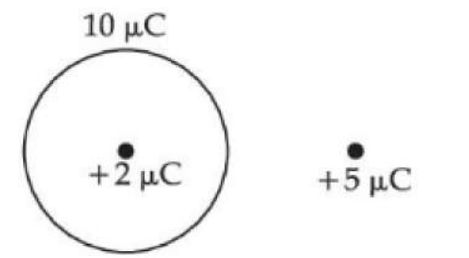
A thin metallic spherical shell contains a charge +10 μC on it. A point charge +2 μC is placed at the centre of the shell and another charge +5 μC is placed outside it as shown. The force on the charge +2 μC at the centre is:
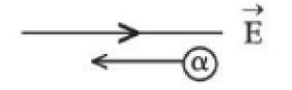
In the figure, an α-particle moves a distance l in a uniform electric field E as shown. Does the Electric Field do a positive or a negative work on the α-particle? Does the electric potential energy of the α-particle increase or decrease?
The force between two electric charges is expressed by the equation:
F = (k q1 q2) / r2
Which of the following is a correct statement?


