The force between two electric charges is expressed by the equation: F = (k q1 q2) / r2 Which of the following is a correct statement?
The equation applies to point charges
The given equation is Coulomb’s law, which states that the electrostatic force between two point charges is directly proportional to the product of their magnitudes and inversely proportional to the square of the distance between them. This law is valid for point charges in free space or air.
- Option (b) is incorrect because k in Coulomb’s law is the electrostatic constant (9 × 10⁹ N·m²/C²), not Boltzmann’s constant.
- Option (c) is incorrect because r represents the distance between the charges, not the radius of spheres.
- Option (d) is incomplete and incorrect.
Thus, the correct answer is (a).
Important Questions from Electric Charges and Fields
Two charged particles, placed at a distance d apart in vacuum, exert a force F on each other. Now, each of the charges is doubled. To keep the force unchanged, the distance between the charges should be changed to:
When a slab of insulating material 4 mm thick is introduced between the plates of a parallel plate capacitor of separation 4 mm, it is found that the distance between the plates has to be increased by 3.2 mm to restore the capacity to its original value. The dielectric constant of the material is:
Match List - I with List - II.
List - I List - II (A) Electric Field (I) [LTA] (B) Electric Flux (II) [L2] (C) Electric Dipole Moment (III) [ML3T−3A−1] (D) Area Vector Element (IV) [MLT−3A−1] Choose the correct answer from the options given below:
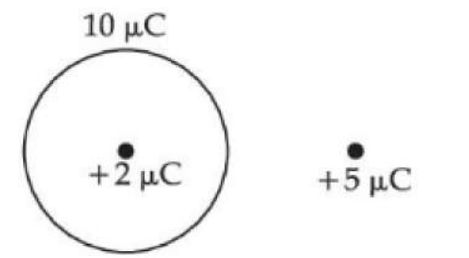
A thin metallic spherical shell contains a charge +10 μC on it. A point charge +2 μC is placed at the centre of the shell and another charge +5 μC is placed outside it as shown. The force on the charge +2 μC at the centre is:
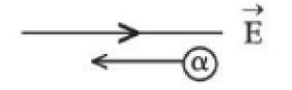
In the figure, an α-particle moves a distance l in a uniform electric field E as shown. Does the Electric Field do a positive or a negative work on the α-particle? Does the electric potential energy of the α-particle increase or decrease?