
Which of the following letter-clusters will replace the question mark (?) in the given series to make it logically complete? ADZ, GJF, MPL, SVR, ?
YBX
Understanding the Letter Series Problem
The problem presents a series of letter clusters: ADZ, GJF, MPL, SVR, ?. We need to identify the logical pattern or rule that governs the transition from one cluster to the next and use this rule to find the missing cluster that replaces the question mark.
Analyzing the Pattern in the Letter Clusters
To solve letter series problems, we usually look at the progression of each letter position independently or the cluster as a whole. In this case, let's analyze the pattern for the first, second, and third letters across the series.
Analyzing the First Letter
Let's look at the sequence of the first letters from each cluster:
- A (from ADZ)
- G (from GJF)
- M (from MPL)
- S (from SVR)
- ? (the first letter of the next cluster)
Now let's consider their positions in the English alphabet:
- A is the 1st letter.
- G is the 7th letter.
- M is the 13th letter.
- S is the 19th letter.
Let's find the difference in positions between consecutive letters:
- From A to G: Position ${7 - 1 = 6}$ (a difference of 6 positions).
- From G to M: Position ${13 - 7 = 6}$ (a difference of 6 positions).
- From M to S: Position ${19 - 13 = 6}$ (a difference of 6 positions).
The pattern for the first letter is a consistent increase of 6 positions in the alphabet. To find the next first letter, we add 6 positions to the position of S (19th letter):
${19 + 6 = 25}$. The 25th letter of the alphabet is Y.
So, the first letter of the next cluster is Y.
Analyzing the Second Letter
Next, let's look at the second letter of each cluster:
- D (from ADZ)
- J (from GJF)
- P (from MPL)
- V (from SVR)
- ? (the second letter of the next cluster)
Their positions in the alphabet are:
- D is the 4th letter.
- J is the 10th letter.
- P is the 16th letter.
- V is the 22nd letter.
Let's find the difference in positions:
- From D to J: Position ${10 - 4 = 6}$ (a difference of 6 positions).
- From J to P: Position ${16 - 10 = 6}$ (a difference of 6 positions).
- From P to V: Position ${22 - 16 = 6}$ (a difference of 6 positions).
The pattern for the second letter is also a consistent increase of 6 positions. To find the next second letter, we add 6 positions to the position of V (22nd letter). Remember that after Z (26th letter), we wrap around to A.
${22 + 6 = 28}$. Since there are 26 letters, we find the remainder when dividing by 26, or subtract 26: ${28 - 26 = 2}$. The 2nd letter of the alphabet is B.
So, the second letter of the next cluster is B.
Analyzing the Third Letter
Finally, let's examine the third letter of each cluster:
- Z (from ADZ)
- F (from GJF)
- L (from MPL)
- R (from SVR)
- ? (the third letter of the next cluster)
Their positions in the alphabet are:
- Z is the 26th letter (or we can consider it position 0 when wrapping around).
- F is the 6th letter.
- L is the 12th letter.
- R is the 18th letter.
Let's find the difference in positions (considering Z as 0 for the calculation from Z to F):
- From Z to F: Position ${6 - 0 = 6}$ (a difference of 6 positions).
- From F to L: Position ${12 - 6 = 6}$ (a difference of 6 positions).
- From L to R: Position ${18 - 12 = 6}$ (a difference of 6 positions).
The pattern for the third letter is also a consistent increase of 6 positions. To find the next third letter, we add 6 positions to the position of R (18th letter):
${18 + 6 = 24}$. The 24th letter of the alphabet is X.
So, the third letter of the next cluster is X.
Determining the Missing Letter Cluster
By combining the next letters found for each position, we get the missing cluster:
- First letter: Y
- Second letter: B
- Third letter: X
The next letter cluster in the series is YBX.
Summary of the Letter Series Pattern
Each letter in the cluster advances by a fixed number of positions in the alphabet (+6), with wrapping around from Z to A.
| Cluster | 1st Letter (+6) | 2nd Letter (+6) | 3rd Letter (+6) |
|---|---|---|---|
| ADZ | A (1) | D (4) | Z (26/0) |
| GJF | G (7) | J (10) | F (6) |
| MPL | M (13) | P (16) | L (12) |
| SVR | S (19) | V (22) | R (18) |
| ? | Y (25) | B (2) | X (24) |
Revision Table: Alphabetical Positions
Knowing the position of each letter in the alphabet is helpful for solving letter series problems quickly.
| Letter | Position | Letter | Position | Letter | Position |
|---|---|---|---|---|---|
| A | 1 | J | 10 | S | 19 |
| B | 2 | K | 11 | T | 20 |
| C | 3 | L | 12 | U | 21 |
| D | 4 | M | 13 | V | 22 |
| E | 5 | N | 14 | W | 23 |
| F | 6 | O | 15 | X | 24 |
| G | 7 | P | 16 | Y | 25 |
| H | 8 | Q | 17 | Z | 26 |
| I | 9 | R | 18 |
Additional Information: Solving Letter Series
Here are some common strategies for solving letter series questions:
- Check the difference in alphabetical position between corresponding letters in consecutive terms. The difference might be constant, increasing, decreasing, or alternating.
- Look for patterns involving vowels and consonants.
- See if the series involves reversing letters or other transformations.
- Consider if there's a pattern based on skipping a certain number of letters.
- Practice with various types of series to become familiar with different patterns.
Regular practice helps in quickly recognizing patterns during exams.
Similar Questions
A word is represented by only one set of numbers as given in any one of the alternatives. The sets of numbers given in the alternatives are represented by two classes of alphabets as shown in the given two matrices. The columns and rows of Matrix-I are numbered from 0 to 4 and that of Matrix-II are numbered from 5 to 9. A letter from these matrices can be represented by its row and next by its column, for example, 'Z' can be represented by 87, 29, etc., and 'T' can be represented by 96, 95, etc. Similarly, you have to identify the set for the word "MAZE".
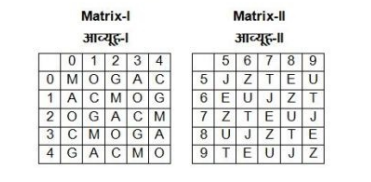
In each of the following questions, a specific rearrangement pattern has been applied to the first word to form the second. Apply the same rearrangement to the third word and choose the correct answer from the given alternatives.
PRINTING : RPNIITGN :: PROTOCOL : ?
In each of the following questions, a word is transformed into another using a specific alphabetic pattern (such as letter shifting or substitution). Apply the same transformation to the third word to determine the correct answer from the given options.
HOUSE : GNTRD :: ? : KHFGS
In a certain code language, 'TRIED' is coded as '54123' and 'TREAD' is coded as '12365'. What is the code for 'I' in the given code language?
In a certain code language, if ‘PDFJARS’ is written as ‘OCELZQR’ and ‘MHCXBTU’ is written as ‘LGBZAST’, how will ‘ZVDGENQ’ be written in the same code language?
- If DESIGN is written as FGUIGL, how is VISION written?
Each vowel In the word “CAPSULE” Is changed to the previous letter In the English alphabetical series and each consonant is changed to the following letter in the English alphabetical series. In the newly formed word, how many alphabets are there in the English alphabetical series between the alphabet which is 3rd from the left and 3rd from the right?
- If COLD is coded as DPME, then HEAT will be coded as?
In each of the following questions, a specific rearrangement of letters has been applied to the first word to form the second. Apply the same rearrangement pattern to the third word and choose the correct answer from the given options.
METAPHOR : EMATHPRO :: NORMAL : ?
In a certain code, NIGHT is written as OHJIS. How will LIGHT be written?
Important Questions from Coding Decoding
In a code language, INDICATOR is written as JOEJBCVQT. How will EMOTIONAL be written in that language?
There are two rows, each containing 3 numbers. Below are some rules to be used to get the resultant number for each row separately. Use the rule from left to right for each row and find the answer to the question.
Rule:
1. If an even number is followed by an even number, then the first number will be subtracted from the second.
2. If an odd number is followed by an odd number, then both will be added.
3. If an odd number is followed by an even number, then the even number will be subtracted from the square of the odd number.
4. If an even number is followed by an odd number, then the odd number will be subtracted from the even number.
Row I: 9,11, 34
Row II: 16, 9, 8
What is the difference between the resultant numbers in the first row and the second row
In a certain code language, 'I belong to you' is written as '# @ © *', 'you belong to them' is written as '©@ % *', 'we belong them' is written as '+ %©'. What is the code for 'we to you' in that code language?
In a certain code language, 'You are good' is written as '@ $ #', 'Good boys like you' is written as '& * @ #', 'I and you go' is written as '© < + @ '. What is the code for 'boys are like' in that code language?
In a certain code language, 'My Best Friend' is coded as 356, "best teacher best friend" is coded as 5456, then 'My friend best Teacher' would be coded as:



