
In a certain code language, if ‘PDFJARS’ is written as ‘OCELZQR’ and ‘MHCXBTU’ is written as ‘LGBZAST’, how will ‘ZVDGENQ’ be written in the same code language?
YUCIDMP
Understanding Coding Decoding Problems
Coding-decoding questions are common in logical reasoning sections of various exams. These questions test your ability to identify a specific pattern or rule used to convert a word or number into a coded form. To solve them, you need to analyze the given examples, find the pattern, and then apply it to the word you need to code.
Analyzing the Given Code Language Examples
We are given two examples of words coded in a certain code language:
- ‘PDFJARS’ is written as ‘OCELZQR’
- ‘MHCXBTU’ is written as ‘LGBZAST’
Let's examine the first example, comparing each letter of the original word ‘PDFJARS’ with the corresponding letter in the coded word ‘OCELZQR’.
- P to O: O is one letter before P in the alphabet (-1 position).
- D to C: C is one letter before D in the alphabet (-1 position).
- F to E: E is one letter before F in the alphabet (-1 position).
- J to L: L is two letters after J in the alphabet (+2 positions).
- A to Z: Z is one letter before A in the alphabet, considering the alphabet wraps around (A to Z is -1 position).
- R to Q: Q is one letter before R in the alphabet (-1 position).
- S to R: R is one letter before S in the alphabet (-1 position).
Now, let's check if the same pattern holds for the second example, ‘MHCXBTU’ coded as ‘LGBZAST’.
- M to L: L is one letter before M (-1).
- H to G: G is one letter before H (-1).
- C to B: B is one letter before C (-1).
- X to Z: Z is two letters after X (+2).
- B to A: A is one letter before B (-1).
- T to S: S is one letter before T (-1).
- U to T: T is one letter before U (-1).
Yes, the pattern is consistent across both examples! The rule is to change the 1st, 2nd, 3rd, 5th, 6th, and 7th letters by moving one position back in the alphabet (-1), and change the 4th letter by moving two positions forward in the alphabet (+2).
Applying the Code Language Pattern to ZVDGENQ
Now we need to apply the identified pattern (-1, -1, -1, +2, -1, -1, -1) to the word ‘ZVDGENQ’ to find its coded form in the same code language.
- 1st letter Z: Z - 1 position → Y
- 2nd letter V: V - 1 position → U
- 3rd letter D: D - 1 position → C
- 4th letter G: G + 2 positions → I
- 5th letter E: E - 1 position → D
- 6th letter N: N - 1 position → M
- 7th letter Q: Q - 1 position → P
Combining these results, the coded word for ‘ZVDGENQ’ is ‘YUCIDMP’.
Verification with Options
Let's compare our derived coded word ‘YUCIDMP’ with the given options:
- XUYCIMP
- XUCDEMQ
- XVDEDNO
- YUCIDMP
Our result ‘YUCIDMP’ matches option 4.
Coding Decoding Solution Summary
The code language uses a specific positional transformation for each letter based on its position in the word. The pattern is backward shift by 1 position for letters 1, 2, 3, 5, 6, 7 and forward shift by 2 positions for the 4th letter. Applying this rule to ‘ZVDGENQ’ gives ‘YUCIDMP’.
| Original Word | Coded Word | Position | Rule | Explanation |
|---|---|---|---|---|
| P | O | 1st | -1 | P → O |
| D | C | 2nd | -1 | D → C |
| F | E | 3rd | -1 | F → E |
| J | L | 4th | +2 | J → K → L |
| A | Z | 5th | -1 | A → Z (alphabet wrap) |
| R | Q | 6th | -1 | R → Q |
| S | R | 7th | -1 | S → R |
| Original Word (ZVDGENQ) | Position | Rule Applied | Coded Letter |
|---|---|---|---|
| Z | 1st | -1 | Y |
| V | 2nd | -1 | U |
| D | 3rd | -1 | C |
| G | 4th | +2 | I |
| E | 5th | -1 | D |
| N | 6th | -1 | M |
| Q | 7th | -1 | P |
Therefore, the coded word for ‘ZVDGENQ’ is ‘YUCIDMP’.
Revision Table: Coding Decoding Practice
Understanding different types of coding patterns is key to mastering coding decoding questions. Here’s a quick look at common patterns:
- Letter Shifting (like in this question, fixed shift or positional shift)
- Reverse Ordering
- Substitution (replacing letters with others)
- Mixed patterns (combining shifting and substitution or other rules)
- Number or Symbol Coding
Additional Information: Mastering Code Language Puzzles
To improve your skills in solving code language problems, practice regularly. Pay attention to details like the length of the words, the position of letters, and whether the alphabet wraps around from A to Z or Z to A. Sometimes the pattern might involve vowel/consonant changes, reversing the word, or using numbers instead of letters. Always check your identified pattern against all given examples before applying it to the target word.
Similar Questions
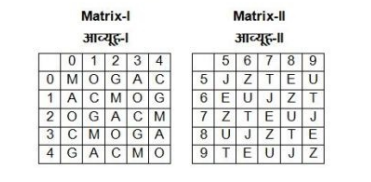
A word is represented by only one set of numbers as given in any one of the alternatives. The sets of numbers given in the alternatives are represented by two classes of alphabets as shown in the given two matrices. The columns and rows of Matrix-I are numbered from 0 to 4 and that of Matrix-II are numbered from 5 to 9. A letter from these matrices can be represented by its row and next by its column, for example, 'Z' can be represented by 87, 29, etc., and 'T' can be represented by 96, 95, etc. Similarly, you have to identify the set for the word "MAZE".
Which of the following letter-clusters will replace the question mark (?) in the given series to make it logically complete?
ADZ, GJF, MPL, SVR, ?
In a certain code language, 'TRIED' is coded as '54123' and 'TREAD' is coded as '12365'. What is the code for 'I' in the given code language?
In a certain code, "CLEAN" is written as "BKDZM".
What is the code for GLASS?If in a code, MANGO is written as NZOHQ, then how is APPLE written?
- If DESIGN is written as FGUIGL, how is VISION written?
If each letter is coded as its position in reverse (Z=1, Y=2,..., A=26), what is ROAD?
In a certain code language, each letter is assigned a unique digit. Based on the given codes for specific words, determine the code for the target word using the same logic. If MOUSE is coded as 45291 and RAT as 786, how is STORE coded?
In a code language, 'FLOW' is written as 'G#3X', and 'WOLF' is written as 'X3#G'. How is 'FOWL' written?
Each vowel In the word “CAPSULE” Is changed to the previous letter In the English alphabetical series and each consonant is changed to the following letter in the English alphabetical series. In the newly formed word, how many alphabets are there in the English alphabetical series between the alphabet which is 3rd from the left and 3rd from the right?
Important Questions from Coding Decoding
In a code language, INDICATOR is written as JOEJBCVQT. How will EMOTIONAL be written in that language?
There are two rows, each containing 3 numbers. Below are some rules to be used to get the resultant number for each row separately. Use the rule from left to right for each row and find the answer to the question.
Rule:
1. If an even number is followed by an even number, then the first number will be subtracted from the second.
2. If an odd number is followed by an odd number, then both will be added.
3. If an odd number is followed by an even number, then the even number will be subtracted from the square of the odd number.
4. If an even number is followed by an odd number, then the odd number will be subtracted from the even number.
Row I: 9,11, 34
Row II: 16, 9, 8
What is the difference between the resultant numbers in the first row and the second row
In a certain code language, 'I belong to you' is written as '# @ © *', 'you belong to them' is written as '©@ % *', 'we belong them' is written as '+ %©'. What is the code for 'we to you' in that code language?
In a certain code language, 'You are good' is written as '@ $ #', 'Good boys like you' is written as '& * @ #', 'I and you go' is written as '© < + @ '. What is the code for 'boys are like' in that code language?
In a certain code language, 'My Best Friend' is coded as 356, "best teacher best friend" is coded as 5456, then 'My friend best Teacher' would be coded as:



