
To determine which of the given sets of numbers is not a Pythagorean triplet, we need to check whether each set satisfies the Pythagorean theorem. A Pythagorean triplet consists of three positive integers \(a\), \(b\), and \(c\), such that \(a^2 + b^2 = c^2\), where \(c\) is the largest number.
- For the set 20, 99, 100:
- Identify the largest number: \(c = 100\).
- Apply the Pythagorean theorem: \(20^2 + 99^2 = 400 + 9801 = 10201\) and \(100^2 = 10000\).
- Since \(10201 \neq 10000\), this set does not satisfy the Pythagorean theorem.
- For the set 8, 15, 17:
- Identify the largest number: \(c = 17\).
- Apply the Pythagorean theorem: \(8^2 + 15^2 = 64 + 225 = 289\) and \(17^2 = 289\).
- Since \(289 = 289\), this is a Pythagorean triplet.
- For the set 12, 35, 37:
- Identify the largest number: \(c = 37\).
- Apply the Pythagorean theorem: \(12^2 + 35^2 = 144 + 1225 = 1369\) and \(37^2 = 1369\).
- Since \(1369 = 1369\), this is a Pythagorean triplet.
- For the set 20, 21, 29:
- Identify the largest number: \(c = 29\).
- Apply the Pythagorean theorem: \(20^2 + 21^2 = 400 + 441 = 841\) and \(29^2 = 841\).
- Since \(841 = 841\), this is a Pythagorean triplet.
Thus, the set 20, 99, 100 is not a Pythagorean triplet as it does not satisfy the condition \(a^2 + b^2 = c^2\).
Similar Questions
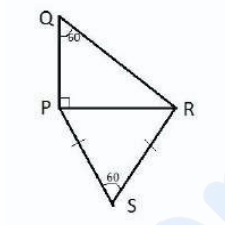
In the given figure, if \(RS = 3\sqrt{3} \text{ cm}\) and \(RPS\) is an equilateral triangle, then find the value of \(QR\)
- In a right angled triangle, with angle at \(A\) being \(90^\circ\), the side \(AB\) is of length 3cm and \(BC\) is 12 cm. What is the length of side \(AC\)?
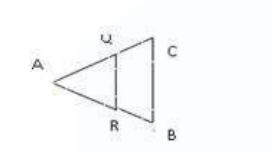
For a pair of similar triangles shown in the figure, the angles made at $B$ and $R$ are same in both the triangles $BAC$ and $RAQ$. If the ratio of the areas of the two triangles is 2:1, and if the area of $BAC$ is $100\text{ cm}^2$ then what is the area of $RAQ$ in sq.cm.?
- In a triangle $ABC$, the length of the side $AB$ is 2m, the angle at $C$ is $60^\circ$ and the angle at $B$ is $30^\circ$, what is the length of side $AC$?
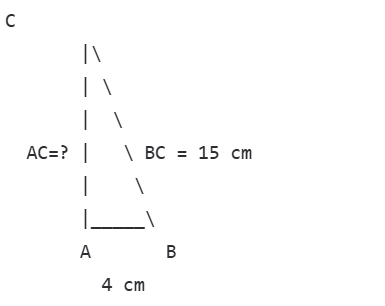
In a right angled triangle, with angle at A being , the side $AB$ is of length 4cm and $BC$ is 15 cm. What is the length of side $AC$?
- Triangles $PQR$ and $ABC$ are similar triangles.
Triangle $ABC$ have the following sides.
$AB = 36\text{ cm}$
$AC = 20\text{ cm}$
$BC = 48\text{ cm}$
Triangle $PQR$ have the following sides:
$PQ = 9\text{ cm}$
$PR = 5\text{ cm}$
What is the length of side $RQ$ =? - What is the area of the triangle in sq. cm. with a base of 10 cm and sides of length 6 cm each?
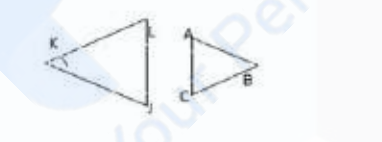
What is the angle at $B$ in the triangle $ABC$, if the angle made at $K$ is $30^\circ$ and the triangles shown in the figure are similar?
- In a triangle the length of the sides, $AB$ is 3m and $BC$ is 5m what is the length of $AC$, if the angle formed at $B$ is $60^\circ$
- In a triangle \(\Delta ABC\ AB= 13\text{ cm}, BC=84\text{cm}, \text{and } \angle B=90^\circ\), then length of AC will be
Important Questions from Triangles
What is \(AB + BC\) equal to?
In the given figure, if \(RS = 3\sqrt{3} \text{ cm}\) and \(RPS\) is an equilateral triangle, then find the value of \(QR\)
- In a right angled triangle, with angle at \(A\) being \(90^\circ\), the side \(AB\) is of length 3cm and \(BC\) is 12 cm. What is the length of side \(AC\)?
For a pair of similar triangles shown in the figure, the angles made at $B$ and $R$ are same in both the triangles $BAC$ and $RAQ$. If the ratio of the areas of the two triangles is 2:1, and if the area of $BAC$ is $100\text{ cm}^2$ then what is the area of $RAQ$ in sq.cm.?
- In a triangle $ABC$, the length of the side $AB$ is 2m, the angle at $C$ is $60^\circ$ and the angle at $B$ is $30^\circ$, what is the length of side $AC$?



