
The problem asks for the length of side AC in a triangle \(\Delta ABC\), given the lengths of sides AB and BC, and the angle between them (\(\angle B = 90^\circ\)).
Applying the Pythagorean Theorem
Since \(\angle B = 90^\circ\), the triangle \(\Delta ABC\) is a right-angled triangle. The side AC is opposite the right angle, making it the hypotenuse. Sides AB and BC are the legs of the triangle.
We can use the Pythagorean theorem, which states that in a right-angled triangle, the square of the hypotenuse (the side opposite the right angle) is equal to the sum of the squares of the other two sides (legs).
The formula is: \(AC^2 = AB^2 + BC^2\)
Calculating the Length of AC
- Substitute the given values:
We are given \(AB = 13\text{ cm}\) and \(BC = 84\text{ cm}\).
\(AC^2 = (13\text{ cm})^2 + (84\text{ cm})^2\)
- Calculate the squares of the sides:
\(13^2 = 169\)
\(84^2 = 7056\)
\(AC^2 = 169\text{ cm}^2 + 7056\text{ cm}^2\)
- Sum the squares:
\(AC^2 = 7225\text{ cm}^2\)
- Find the square root to get the length of AC:
\(AC = \sqrt{7225\text{ cm}^2}\)
\(AC = 85\text{ cm}\)
Therefore, the length of AC is 85 cm.
Similar Questions
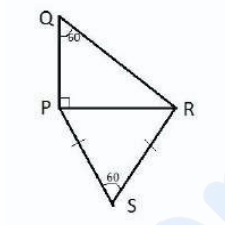
In the given figure, if \(RS = 3\sqrt{3} \text{ cm}\) and \(RPS\) is an equilateral triangle, then find the value of \(QR\)
- In a right angled triangle, with angle at \(A\) being \(90^\circ\), the side \(AB\) is of length 3cm and \(BC\) is 12 cm. What is the length of side \(AC\)?
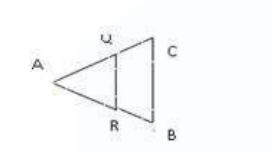
For a pair of similar triangles shown in the figure, the angles made at $B$ and $R$ are same in both the triangles $BAC$ and $RAQ$. If the ratio of the areas of the two triangles is 2:1, and if the area of $BAC$ is $100\text{ cm}^2$ then what is the area of $RAQ$ in sq.cm.?
- In a triangle $ABC$, the length of the side $AB$ is 2m, the angle at $C$ is $60^\circ$ and the angle at $B$ is $30^\circ$, what is the length of side $AC$?
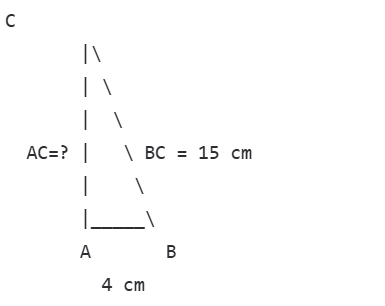
In a right angled triangle, with angle at A being , the side $AB$ is of length 4cm and $BC$ is 15 cm. What is the length of side $AC$?
- Triangles $PQR$ and $ABC$ are similar triangles.
Triangle $ABC$ have the following sides.
$AB = 36\text{ cm}$
$AC = 20\text{ cm}$
$BC = 48\text{ cm}$
Triangle $PQR$ have the following sides:
$PQ = 9\text{ cm}$
$PR = 5\text{ cm}$
What is the length of side $RQ$ =? - What is the area of the triangle in sq. cm. with a base of 10 cm and sides of length 6 cm each?
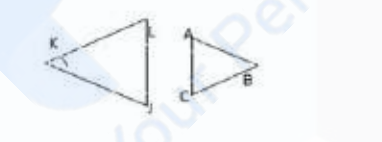
What is the angle at $B$ in the triangle $ABC$, if the angle made at $K$ is $30^\circ$ and the triangles shown in the figure are similar?
- In a triangle the length of the sides, $AB$ is 3m and $BC$ is 5m what is the length of $AC$, if the angle formed at $B$ is $60^\circ$
- Which of the following is not a Pythagorean triplet?
Important Questions from Triangles
What is \(AB + BC\) equal to?
In the given figure, if \(RS = 3\sqrt{3} \text{ cm}\) and \(RPS\) is an equilateral triangle, then find the value of \(QR\)
- In a right angled triangle, with angle at \(A\) being \(90^\circ\), the side \(AB\) is of length 3cm and \(BC\) is 12 cm. What is the length of side \(AC\)?
For a pair of similar triangles shown in the figure, the angles made at $B$ and $R$ are same in both the triangles $BAC$ and $RAQ$. If the ratio of the areas of the two triangles is 2:1, and if the area of $BAC$ is $100\text{ cm}^2$ then what is the area of $RAQ$ in sq.cm.?
- In a triangle $ABC$, the length of the side $AB$ is 2m, the angle at $C$ is $60^\circ$ and the angle at $B$ is $30^\circ$, what is the length of side $AC$?



