
In a right angled triangle, with angle at A being , the side $AB$ is of length 4cm and $BC$ is 15 cm. What is the length of side $AC$? 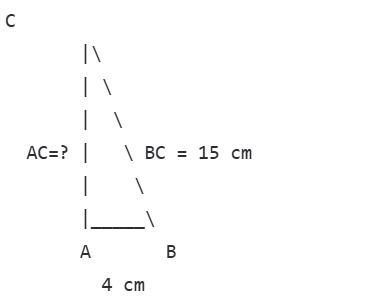
To find the length of side \( AC \) in the right-angled triangle \( \triangle ABC \), we can use the Pythagorean theorem. The Pythagorean theorem states that in a right-angled triangle, the square of the length of the hypotenuse (the side opposite the right angle) is equal to the sum of the squares of the lengths of the other two sides. The theorem is given by:
\(c^2 = a^2 + b^2\)
Here, \( BC \) is the hypotenuse, \( AB = 4 \text{ cm} \), and \( BC = 15 \text{ cm} \). We need to find \( AC \).
According to the Pythagorean theorem:
\(BC^2 = AB^2 + AC^2\)
Plugging in the known values:
\((15)^2 = (4)^2 + AC^2\)
\(225 = 16 + AC^2\)
Subtracting 16 from both sides:
\(225 - 16 = AC^2\)
\(209 = AC^2\)
Taking the square root of both sides gives:
\(AC = \sqrt{209}\)
Hence, the length of side \( AC \) is \(\sqrt{209}\text{ cm}\). Therefore, the correct answer is option \(\sqrt{209}\text{ cm}\).
Similar Questions
- It is given that, \(\Delta ABC \sim \Delta EDF\) such that \(AB = 5 \text{ cm}\), \(AC = 7.5 \text{ cm}\), \(DF = 15 \text{ cm}\) and \(ED = 12.5 \text{ cm}\). The sum of the remaining sides of the triangles is:
In two triangles, ∆ABC ∼ ∆PQR, AB=12cm and PQ=4cm, if AL and PM are altitudes of the respected triangles, then what will be AL : PM?
In the given figure, if \(RS = 3\sqrt{3} \text{ cm}\) and \(RPS\) is an equilateral triangle, then find the value of \(QR\)
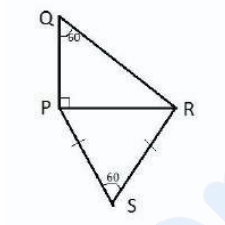
- In a right angled triangle, with angle at \(A\) being \(90^\circ\), the side \(AB\) is of length 3cm and \(BC\) is 12 cm. What is the length of side \(AC\)?
For a pair of similar triangles shown in the figure, the angles made at $B$ and $R$ are same in both the triangles $BAC$ and $RAQ$. If the ratio of the areas of the two triangles is 2:1, and if the area of $BAC$ is $100\text{ cm}^2$ then what is the area of $RAQ$ in sq.cm.?
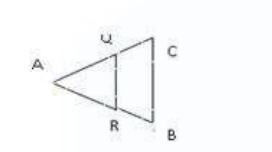
- In a triangle $ABC$, the length of the side $AB$ is 2m, the angle at $C$ is $60^\circ$ and the angle at $B$ is $30^\circ$, what is the length of side $AC$?
- Triangles $PQR$ and $ABC$ are similar triangles.
Triangle $ABC$ have the following sides.
$AB = 36\text{ cm}$
$AC = 20\text{ cm}$
$BC = 48\text{ cm}$
Triangle $PQR$ have the following sides:
$PQ = 9\text{ cm}$
$PR = 5\text{ cm}$
What is the length of side $RQ$ =? - What is the area of the triangle in sq. cm. with a base of 10 cm and sides of length 6 cm each?
What is the angle at $B$ in the triangle $ABC$, if the angle made at $K$ is $30^\circ$ and the triangles shown in the figure are similar?
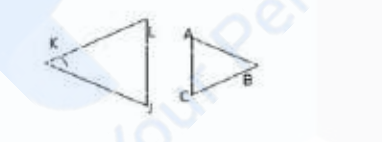
- In a triangle the length of the sides, $AB$ is 3m and $BC$ is 5m what is the length of $AC$, if the angle formed at $B$ is $60^\circ$
Important Questions from Triangles
Among the following options, which are NOT sides of a triangle?
In a Δ ABC, if ∠A = 120° and AB = AC, then the values of ∠B and ∠C are respectively:
In the equilateral Δ ABC, the base BC is trisected at D and E. The line through D, Parallel to AB, meets AC at F and the line through E parallel to AC meets AB at G. If EG and DF intersect at H, then what is the ratio of the sum of the area of parallelogram AGHF and the area of the Δ DHE to the area of the Δ ABC?
The product of the perimeter of a triangle, the radius of its in‐circle, and a number gives the area of the triangle. The number is
A man goes 24 m towards east and then 10 m towards north. How far is he away from his initial position?



