
Understanding $\alpha$-Helix Destabilization by Amino Acid Mutations
The $\alpha$-helix ($\alpha$-helix) is a common secondary structure in proteins stabilized by hydrogen bonds between the backbone amide hydrogen of one amino acid residue and the backbone carbonyl oxygen of another residue, typically four positions earlier in the sequence ($i+4 \rightarrow i$). This regular structure requires specific backbone dihedral angles ($\phi$ and $\psi$) that allow for stable formation.
Amino Acids Affecting $\alpha$-Helix Stability
Certain amino acid residues can disrupt the formation or stability of an $\alpha$-helix due to their unique side chain properties:
- Proline: It has a cyclic side chain where the amino group is part of the ring. This structure introduces conformational rigidity, preventing the necessary rotation of the peptide backbone. Proline lacks an amide hydrogen atom required for hydrogen bonding within the helix. Consequently, proline is often referred to as a "helix breaker".
- Charged Residues: While charged residues can participate in stabilizing salt bridges or destabilizing interactions (like charges near each other), their side chains generally allow for the required backbone conformation.
- Steric Hindrance: Bulky side chains can sometimes cause steric clashes, but small changes between similar amino acids (like valine and isoleucine) usually have minimal impact.
Analysis of Options
Let's evaluate how each mutation affects the $\alpha$-helix:
- Valine to Isoleucine: Both are branched, hydrophobic amino acids. This change involves similar side chains and is unlikely to significantly disrupt the $\alpha$-helix structure.
- Methionine to Proline: Methionine is compatible with $\alpha$-helices. Replacing it with Proline introduces a "helix breaker" due to its conformational restriction and lack of hydrogen bonding capability, severely disrupting the helical structure.
- Aspartic acid to Glutamic acid: Both are acidic amino acids with flexible side chains. They are chemically similar and their substitution is unlikely to cause major structural disruption in an $\alpha$-helix.
- Histidine to Arginine: Both are basic amino acids. While they have different side chain properties, both can generally accommodate $\alpha$-helical structures. This change is less disruptive than introducing Proline.
Therefore, the mutation most likely to adversely affect the $\alpha$-helix structure is the introduction of Proline.
Important Questions from Protein Structure Folding Alpha Helix
- A 25 amino acid $\alpha$-helical protein is spanning the thickness of a mammalian cell membrane. Using the average dimensional parameters of a typical $\alpha$-helix, the thickness of the membrane will be ________ $\text{\AA}$ (rounded off to one decimal place).
The following diagram represents energy states of different protein folding steps, which includes-
1. Folded
2. Transition
3. Molten globule
4. Unfolded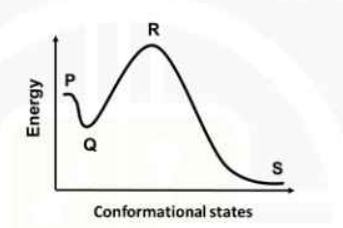
Find the correct match of folding steps (1 to 4) with the energy state (P to S) in the diagram.- In a $\alpha$-helix, the R-groups on the amino acid residues
- Which one of the following pairs of amino-acids in the protein has high propensity to take up the $\alpha$-helix conformation?
- Which one of the following closely defines 'Molten Globule' state of a protein?


