Amino Acid Propensity for $\alpha$-Helix Formation
The formation of secondary structures like the $\alpha$-helix in proteins is influenced by the specific amino acids present. Certain amino acids are known to favor or disrupt $\alpha$-helix formation.
Analysis of Amino Acid Pairs
We need to identify the pair with the highest propensity to form an $\alpha$-helix:
- Gly-Asp: Glycine (Gly) has high conformational flexibility and low $\alpha$-helix propensity. Aspartic acid (Asp) is charged.
- Pro-His: Proline (Pro) disrupts $\alpha$-helices due to its rigid structure and lack of an amide hydrogen for backbone H-bonding. Histidine (His) is charged.
- Gly-Pro: Both Glycine and Proline are generally considered unfavorable for $\alpha$-helix formation.
- Ala-Arg: Alanine (Ala) is a strong $\alpha$-helix promoter due to its small, non-polar side chain. Arginine (Arg) is a charged residue, but charged residues can be incorporated into helices, and Alanine strongly favors the helical conformation.
Identifying the Best Pair
Based on known propensities:
- Alanine (Ala) is one of the best helix formers.
- Proline (Pro) and Glycine (Gly) are known helix breakers or destabilizers.
- Charged residues like Aspartic Acid (Asp) and Arginine (Arg) can be accommodated but don't inherently promote helical structure as strongly as Ala.
Comparing the pairs, Ala-Arg combines a strong helix-forming residue (Ala) with a residue that can be stabilized within a helix (Arg), making it the most likely pair to have a high propensity for $\alpha$-helix formation compared to pairs involving Proline or Glycine.
Important Questions from Protein Structure Folding Alpha Helix
- A 25 amino acid $\alpha$-helical protein is spanning the thickness of a mammalian cell membrane. Using the average dimensional parameters of a typical $\alpha$-helix, the thickness of the membrane will be ________ $\text{\AA}$ (rounded off to one decimal place).
The following diagram represents energy states of different protein folding steps, which includes-
1. Folded
2. Transition
3. Molten globule
4. Unfolded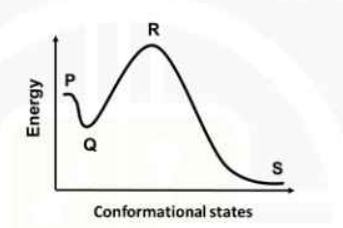
Find the correct match of folding steps (1 to 4) with the energy state (P to S) in the diagram.- In a $\alpha$-helix, the R-groups on the amino acid residues
- Which one of the following closely defines 'Molten Globule' state of a protein?
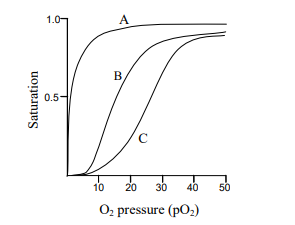
In an individual, three distinct proteins bind oxygen depending on the location and development stage. While hemoglobin is the major oxygen binding protein in adults, myoglobin is present in skeletal muscles and fetal hemoglobin is present in fetal stage only. The following graph shows the oxygen binding capacity of these proteins. The A, B and C plots represent oxygen binding capacity of