Calculating Membrane Thickness
To determine the membrane thickness, we need the dimensions of an $\alpha$-helix and the number of amino acids in the protein segment spanning the membrane.
- Number of amino acids = 25
- Average rise per amino acid residue along the axis of an $\alpha$-helix ≈ 1.5 Å
Helix Length Calculation
The total length of the helical segment can be calculated by multiplying the number of amino acids by the average rise per residue:
$Helix Length = (Number of residues) × (Rise per residue)$
Using LaTeX for the expression:
$ \text{Length} = 25 \, \text{residues} \times 1.5 \, \frac{\AA}{\text{residue}} $
$ \text{Length} = 37.5 \, \AA $
Membrane Thickness Determination
Assuming the $\alpha$-helical protein segment spans the membrane perpendicularly, the calculated helix length corresponds to the membrane thickness.
Therefore, the estimated thickness of the cell membrane is 37.5 Å.
Important Questions from Protein Structure Folding Alpha Helix
The following diagram represents energy states of different protein folding steps, which includes-
1. Folded
2. Transition
3. Molten globule
4. Unfolded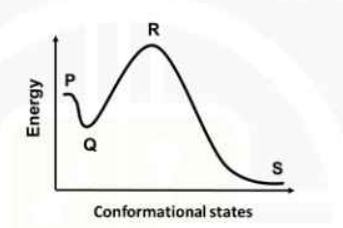
Find the correct match of folding steps (1 to 4) with the energy state (P to S) in the diagram.- In a $\alpha$-helix, the R-groups on the amino acid residues
- Which one of the following pairs of amino-acids in the protein has high propensity to take up the $\alpha$-helix conformation?
- Which one of the following closely defines 'Molten Globule' state of a protein?
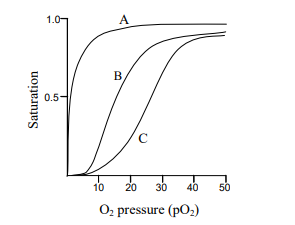
In an individual, three distinct proteins bind oxygen depending on the location and development stage. While hemoglobin is the major oxygen binding protein in adults, myoglobin is present in skeletal muscles and fetal hemoglobin is present in fetal stage only. The following graph shows the oxygen binding capacity of these proteins. The A, B and C plots represent oxygen binding capacity of