Understanding the Protein 'Molten Globule' State
The 'Molten Globule' state is an intermediate step in protein folding. It's characterized by specific structural features:
Key Characteristics of Molten Globule State
- Secondary Structure: Proteins in this state retain a significant amount of their native secondary structures (like alpha-helices and beta-sheets).
- Tertiary Structure: However, the specific, well-defined three-dimensional arrangement of these secondary structures (tertiary structure) is largely lost or significantly relaxed. The overall structure is compact but lacks the rigid definition of the native state.
- Hydrophobic Core: The hydrophobic core, typical of native proteins, is less formed or exposed in the molten globule state.
- Flexibility: This state exhibits increased flexibility compared to the native state.
Analysis of Options
Let's analyze the given options based on these characteristics:
- Option 1: State with high degree of secondary structure and loss of tertiary structure - This accurately describes the molten globule state. Secondary structures are largely intact, while the rigid tertiary structure is disrupted. This matches the definition.
- Option 2: State with complete loss of secondary structure - This describes a completely unfolded or denatured state, not the molten globule.
- Option 3: Completely unfolded state - This is synonymous with Option 2 and does not represent the molten globule state, which retains secondary structure.
- Option 4: Loss of quaternary structure - Quaternary structure involves the arrangement of multiple protein subunits. While a protein might lose its quaternary structure during unfolding or denaturation, this is distinct from the definition of the molten globule state, which focuses on the changes within a single polypeptide chain's secondary and tertiary structure.
Therefore, the state with a high degree of secondary structure and loss of tertiary structure is the best definition of the Molten Globule state.
Important Questions from Protein Structure Folding Alpha Helix
- A 25 amino acid $\alpha$-helical protein is spanning the thickness of a mammalian cell membrane. Using the average dimensional parameters of a typical $\alpha$-helix, the thickness of the membrane will be ________ $\text{\AA}$ (rounded off to one decimal place).
The following diagram represents energy states of different protein folding steps, which includes-
1. Folded
2. Transition
3. Molten globule
4. Unfolded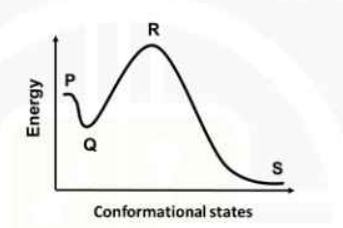
Find the correct match of folding steps (1 to 4) with the energy state (P to S) in the diagram.- In a $\alpha$-helix, the R-groups on the amino acid residues
- Which one of the following pairs of amino-acids in the protein has high propensity to take up the $\alpha$-helix conformation?
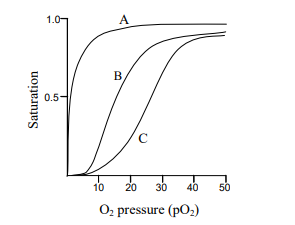
In an individual, three distinct proteins bind oxygen depending on the location and development stage. While hemoglobin is the major oxygen binding protein in adults, myoglobin is present in skeletal muscles and fetal hemoglobin is present in fetal stage only. The following graph shows the oxygen binding capacity of these proteins. The A, B and C plots represent oxygen binding capacity of