Alpha Helix R-Groups Location
In an $\alpha$-helix, the polypeptide backbone forms the core of the helix, stabilized by hydrogen bonds between backbone amide and carbonyl groups. The side chains, known as R-groups, extend outwards from this core structure.
- Option A (Correct): R-groups are located on the periphery of the $\alpha$-helix, pointing away from the axis. This positioning allows them to interact with the surrounding solvent or other parts of the protein molecule.
Alpha Helix Handedness and R-Groups
The formation of $\alpha$-helices is influenced by the chirality of the amino acids used.
- Option C (Correct): Proteins are typically composed of L-amino acids. Due to steric interactions between the R-groups and the helix backbone, L-amino acids predominantly favor the formation of right-handed $\alpha$-helices. The specific nature of the R-groups contributes to the stability of this conformation.
- Option D (Correct): While less common in biological systems, D-amino acids can form left-handed $\alpha$-helices. Therefore, the potential exists for R-groups, depending on the chirality of the amino acid residue, to allow for the formation of both right-handed and left-handed helices.
Incorrect Option Analysis
- Option B (Incorrect): The hydrogen bonds that stabilize the $\alpha$-helix structure occur between the backbone atoms (specifically, the N-H group of one amino acid residue and the C=O group of another residue typically four positions earlier in the sequence). R-groups are not directly involved in forming these backbone hydrogen bonds.
Summary of Correct Options
Based on the positioning and the influence of amino acid chirality on helical structure:
- A: R-groups are found on the outside of the helix.
- C: R-groups contribute to the preference for right-handed helices (with L-amino acids).
- D: R-groups allow for the possibility of left-handed helices (with D-amino acids).
Important Questions from Protein Structure Folding Alpha Helix
- A 25 amino acid $\alpha$-helical protein is spanning the thickness of a mammalian cell membrane. Using the average dimensional parameters of a typical $\alpha$-helix, the thickness of the membrane will be ________ $\text{\AA}$ (rounded off to one decimal place).
The following diagram represents energy states of different protein folding steps, which includes-
1. Folded
2. Transition
3. Molten globule
4. Unfolded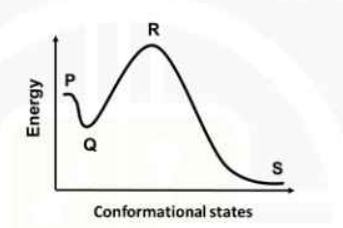
Find the correct match of folding steps (1 to 4) with the energy state (P to S) in the diagram.- Which one of the following pairs of amino-acids in the protein has high propensity to take up the $\alpha$-helix conformation?
- Which one of the following closely defines 'Molten Globule' state of a protein?
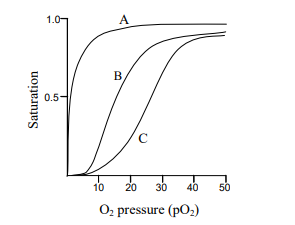
In an individual, three distinct proteins bind oxygen depending on the location and development stage. While hemoglobin is the major oxygen binding protein in adults, myoglobin is present in skeletal muscles and fetal hemoglobin is present in fetal stage only. The following graph shows the oxygen binding capacity of these proteins. The A, B and C plots represent oxygen binding capacity of