
Number Logic Puzzle: Identifying the Outlier
This problem asks us to identify which number among the given options does not share a common characteristic with the others. This type of question tests our ability to recognize patterns and logical connections between numerical values.
Analyzing the Options
Let's examine each number provided in the options:
- Option 1: $123$
- Option 2: $213$
- Option 3: $212$
- Option 4: $312$
Finding the Underlying Pattern
To find the number that does not belong, we can investigate the properties of the digits within each number:
- The number $123$ is composed of the digits $1$, $2$, and $3$. All these digits are distinct (unique).
- The number $213$ is composed of the digits $2$, $1$, and $3$. All these digits are also distinct.
- The number $212$ is composed of the digits $2$, $1$, and $2$. Notice that the digit $2$ appears twice; it is a repeated digit.
- The number $312$ is composed of the digits $3$, $1$, and $2$. All these digits are distinct.
From this analysis, we can see a clear distinction. The numbers $123$, $213$, and $312$ are all formed using three unique digits. In contrast, the number $212$ uses the digit $2$ more than once.
Conclusion: The Number That Does Not Belong
The defining characteristic that separates the numbers is the uniqueness of their digits. Since $123$, $213$, and $312$ all contain unique digits, while $212$ contains a repeated digit, $212$ is the number that does not belong to the group.
Similar Questions
- Which figure doesn't belong based on vertices?
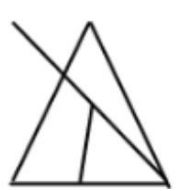
How many straight lines are there in the figure? (Don't consider the extra line if there is another line at 180 degrees)
An unfolded box (cube or cuboid) appeared as shown in the figure, when sheet is folded to form a box. find the number on the face
opposite to 6.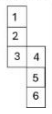
- \(34, \ 68, \ 102, \ 136, \ 170, \ 185\) - which number doesn't follow the series rule?
- Which of the following does NOT belong to the group?
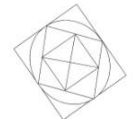
How many triangles are there in the given figure.
- Amazon, Nile, Ganga, Everest - which is not like the others?
Which figure should replace the question mark?
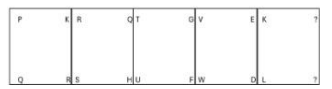
Study the given pattern carefully and select the number that can replace the question mark (?) in it.
15 12 81 17 14 93 15 11 ? Which of the following numbers will replace the question mark (?) in the given series?
4, 11, 21, 37, 62, 109, 171, ?
Important Questions from Miscellaneous
Which gas shields the surface of the earth from ultraviolet radiation from the sun?
Which event is marked as an Intangible Cultural Heritage of Humanity by UNESCO?
Who has been conferred with the rank of the Commander of the Order of the British Empire in 2018?
Who directead the film ‘Bhuvan Shome’?
The book “In my mother’s house” is written by _______



