
Which two numbers from amongst the given options should be interchanged to make the given equation correct? (42 ÷ 7) × 5 = 30 × 120 ÷ (10 + 5 × 2)
10 and 30
Solving Equation by Number Interchange
The question asks us to identify which pair of numbers, when swapped in the given equation, will make the equation mathematically correct. The given equation is:
(42 ÷ 7) × 5 = 30 × 120 ÷ (10 + 5 × 2)
First, let's evaluate the original equation to see if it is correct as it is. We will use the order of operations (BODMAS/PEMDAS).
Left Hand Side (LHS):
Right Hand Side (RHS):
Inside the parenthesis:
Now substitute this back into the RHS expression:
Perform multiplication and division from left to right:
So, the original equation evaluates to:
30 = 180
This is incorrect. Now let's test the given options by swapping the numbers as suggested and re-evaluating the equation.
Let's test the option that swaps 10 and 30.
Testing Interchange of 10 and 30
Original Equation: (42 ÷ 7) × 5 = 30 × 120 ÷ (10 + 5 × 2)
Interchange 10 and 30. The new equation becomes:
(42 ÷ 7) × 5 = 10 × 120 ÷ (30 + 5 × 2)
Let's evaluate the LHS and RHS of this new equation.
Left Hand Side (LHS):
The LHS remains 30, as neither 10 nor 30 is present in the LHS of the original equation.
Right Hand Side (RHS) with 10 and 30 swapped:
Inside the parenthesis, using BODMAS/PEMDAS (Multiplication before Addition):
Substitute this back into the RHS expression:
Perform multiplication and division from left to right:
So, after swapping 10 and 30, the equation evaluates to:
30 = 30
This is correct. Therefore, interchanging 10 and 30 makes the given equation correct.
We can briefly check why other options might not work.
- 10 and 5: Swapping 10 and 5 would change the parenthesis to (10 + 10 × 5) = (10 + 50) = 60 and also change the multiplication in the LHS to (42 ÷ 7) × 10 = 60. This would result in 60 = 30 × 120 ÷ 60, which is 60 = 30 × 2 = 60. Wait, let's re-calculate this carefully. Swapping 10 and 5: LHS: (42 ÷ 7) × 10 = 6 × 10 = 60 RHS: 30 × 120 ÷ (5 + 10 × 2) = 30 × 120 ÷ (5 + 20) = 30 × 120 ÷ 25. 30 × 120 = 3600. 3600 ÷ 25 = 144. So, 60 = 144, which is incorrect.
- 2 and 5: Swapping 2 and 5 changes the parenthesis to (10 + 5 × 5) = (10 + 25) = 35 and the multiplication in the LHS to (42 ÷ 7) × 2 = 6 × 2 = 12. LHS: 12 RHS: 30 × 120 ÷ 35 = 3600 ÷ 35 = 720/7 (not an integer). So, 12 = 720/7, which is incorrect.
- 7 and 2: Swapping 7 and 2 changes the division in the LHS to (42 ÷ 2) × 5 = 21 × 5 = 105 and the multiplication inside the parenthesis in RHS to (10 + 5 × 7) = (10 + 35) = 45. LHS: 105 RHS: 30 × 120 ÷ 45 = 3600 ÷ 45 = 80. So, 105 = 80, which is incorrect.
Only the interchange of 10 and 30 results in a correct equation.
Revision Table: Order of Operations
| Acronym | Order | Operation |
|---|---|---|
| B | 1 | Brackets (or Parentheses) |
| O | 2 | Orders (or Exponents, square roots, etc.) |
| D | 3 | Division |
| M | 3 | Multiplication |
| A | 4 | Addition |
| S | 4 | Subtraction |
Division and Multiplication are performed from left to right. Addition and Subtraction are performed from left to right.
Additional Information: Equation Balancing and Number Puzzles
Problems like this are common in logical reasoning and quantitative aptitude tests. They require careful application of the order of operations (BODMAS/PEMDAS) and systematic testing of the given options. The key is to substitute the swapped numbers correctly into the original equation and then evaluate both sides step-by-step.
Understanding the order of operations is crucial:
- First, solve anything inside Brackets (or Parentheses).
- Next, evaluate Orders (powers, roots, etc.) or Exponents.
- Then, perform Division and Multiplication from left to right.
- Finally, perform Addition and Subtraction from left to right.
When solving equation interchange problems, it's important to be meticulous with calculations for each option to avoid errors.
Similar Questions
Study the given pattern carefully and select the number that can replace the question mark (?) in it.
15 12 81 17 14 93 15 11 ? Select the option that is related to the third word in the same way as the second word is related to the first word.
(The words must be considered as meaningful English words and must not be related to each other based on the number of letters/number of consonants/vowels in the word)
Mirror : Reflection :: Glass : ?
Figure A and B are related in a particular manner. Establish the same relationship between figures C and D by choosing the figure amongst these four options which would replace the question mark in figure D.
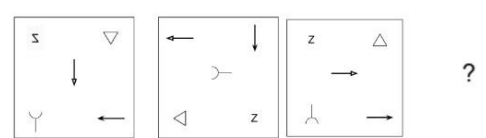
- Choose the CORRECT option.
Address 1: Mr. Rohit Sharma, 123/A, Rose Villa, Green Park, Delhi - 110016
Address 2: Mr. R. Sharma, 123-A, Rose Villa, Green Park, New Delhi - 110016
Are the two addresses likely to refer to the same person? - Address A: Mr. Riya Kapoor, 7/2, Lake View Road, Kolkata - 700029
Address B: Mr. R. Kapoor, 7/2A, Lake View Rd, Kolkata - 700029
What is the most significant difference between the two addresses? How many triangles are in the given figure?
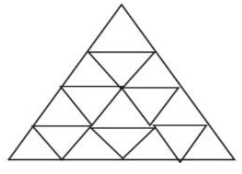
Which of the following numbers will replace the question mark (?) in the given series?
4, 11, 21, 37, 62, 109, 171, ?
If \(5 \bullet = \ 20\) and \(7 \bullet = \ 28\), then \(9 \bullet = \ ?\)
- Find the ODD one out.
Blue, Green, Red, Smooth Select from the alternatives, the box that can be formed by folding the sheet as shown in figure.
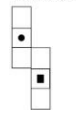
Important Questions from Miscellaneous
Which event is marked as an Intangible Cultural Heritage of Humanity by UNESCO?
Who has been conferred with the rank of the Commander of the Order of the British Empire in 2018?
Who directead the film ‘Bhuvan Shome’?
The book “In my mother’s house” is written by _______
In which state is Vishwa Mitra Ka Tila situated?



