
If \(5 \bullet = \ 20\) and \(7 \bullet = \ 28\), then \(9 \bullet = \ ?\)
To solve the problem, we need to identify the pattern or logic behind the operations with the symbol \(\bullet\) given in the question. Let's analyze the provided relationships:
- Given: \(5 \bullet = 20\). We can interpret this as an operation performed on 5 to get 20.
- Given: \(7 \bullet = 28\). Similarly, an operation is performed on 7 to obtain 28.
We assume that there is some consistent arithmetic operation being applied. Let's look for possible patterns:
- Observe that \(5 \times 4 = 20\). Hence, the operation could be multiplying 5 by 4.
- Observe that \(7 \times 4 = 28\). This suggests the operation is to multiply the number by 4 consistently.
Based on the identified pattern, we hypothesize that \(x \bullet = x \times 4\).
Now, apply this rule to find \(9 \bullet\):
- Using the rule, \(9 \times 4 = 36\).
Therefore, \(9 \bullet = 36\). Thus, the solution is consistent with the pattern observed, and the correct answer is 36.
Similar Questions
Study the given pattern carefully and select the number that can replace the question mark (?) in it.
15 12 81 17 14 93 15 11 ? - Which figure doesn't belong based on vertices?
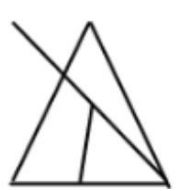
How many straight lines are there in the figure? (Don't consider the extra line if there is another line at 180 degrees)
An unfolded box (cube or cuboid) appeared as shown in the figure, when sheet is folded to form a box. find the number on the face
opposite to 6.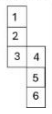
- \(34, \ 68, \ 102, \ 136, \ 170, \ 185\) - which number doesn't follow the series rule?
- Which of the following does NOT belong to the group?
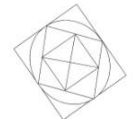
How many triangles are there in the given figure.
- Amazon, Nile, Ganga, Everest - which is not like the others?
Which figure should replace the question mark?
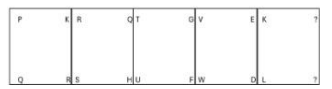
- Choose the CORRECT option.
Address 1: Mr. Rohit Sharma, 123/A, Rose Villa, Green Park, Delhi - 110016
Address 2: Mr. R. Sharma, 123-A, Rose Villa, Green Park, New Delhi - 110016
Are the two addresses likely to refer to the same person?
Important Questions from Miscellaneous
The magazine in which Mahatma Gandhi mentioned what he wanted the Constitution to do is:
Which gas shields the surface of the earth from ultraviolet radiation from the sun?
Which event is marked as an Intangible Cultural Heritage of Humanity by UNESCO?
Who has been conferred with the rank of the Commander of the Order of the British Empire in 2018?
Who directead the film ‘Bhuvan Shome’?



