
Select the option that is related to the third word in the same way as the second word is related to the first word. (The words must be considered as meaningful English words and must not be related to each other based on the number of letters/number of consonants/vowels in the word) Mirror : Reflection :: Glass : ?
Refraction
Understanding the Analogy: Mirror and Reflection
The question asks us to find the relationship between the first pair of words, "Mirror" and "Reflection", and then apply that same relationship to the third word, "Glass", to find the fourth word.
Let's analyze the first pair:
- A Mirror is a surface, usually glass coated with metal, that reflects light.
- Reflection is the phenomenon where light bounces off a surface, like a mirror, and changes direction.
So, the relationship between Mirror and Reflection is that a mirror is a material or object that primarily causes or is associated with the phenomenon of reflection.
Applying the Analogy to Glass
Now, we need to apply this relationship to the word "Glass". What phenomenon is primarily associated with light interacting with glass when light passes through it at an angle?
Consider light passing through a windowpane or a lens made of glass:
- When light strikes a transparent material like glass at an angle, it bends as it enters and exits the material. This bending of light is called Refraction.
- While glass surfaces also cause some reflection, the primary interaction of light passing through glass (especially in lenses or prisms) that is distinct from a mirror's function is refraction.
Therefore, if a mirror is associated with reflection, then glass is primarily associated with refraction when light passes through it.
Evaluating the Options
Let's look at the given options:
- Repulsion: This term typically refers to forces pushing objects away from each other (like magnetic poles). It is not related to how light interacts with glass.
- Retention: This means keeping or holding onto something. It doesn't describe a light phenomenon involving glass.
- Refraction: This is the bending of light as it passes through a different medium, like glass. This aligns with our analysis of how glass interacts with light.
- Retraction: This means pulling back or withdrawing. It is not related to the behavior of light with glass.
Based on the analysis, the phenomenon most closely associated with glass, in the same way that reflection is associated with a mirror, is refraction.
Summary of the Relationship
The analogy follows the pattern:
| Object/Material | Primary Light Phenomenon |
|---|---|
| Mirror | Reflection |
| Glass | Refraction |
Thus, the correct word to complete the analogy is Refraction.
Revision Table: Understanding Light Interaction
| Term | Definition | Example Material |
|---|---|---|
| Reflection | Light bouncing off a surface. Angle of incidence equals angle of reflection (\(\theta_i = \theta_r\)). | Mirror, polished metal |
| Refraction | Light bending as it passes from one medium to another (e.g., air to glass). Governed by Snell's Law (\(n_1 \sin \theta_1 = n_2 \sin \theta_2\)). | Glass (lens, prism, window), water |
| Absorption | Light energy being absorbed by the material and converted into heat or other energy. | Dark coloured objects, filters |
| Transmission | Light passing through a material without being absorbed or reflected significantly. | Transparent materials like clear glass, air |
Additional Information on Light and Materials
Materials interact with light in various ways. While a mirror is designed to maximize reflection, and transparent glass allows for transmission and causes refraction, most materials exhibit a combination of these phenomena to some extent. For example, even a mirror surface absorbs a small amount of light and transmits a tiny amount. Similarly, a piece of glass surface also reflects some light, which is why you can see your reflection in a window, although it's usually not as clear as in a mirror because most light passes through.
In the context of this analogy, the question focuses on the primary and characteristic interaction of light with each material type. For mirrors, it is reflection. For transparent glass, especially when light passes through it, it is refraction.
Similar Questions
- Which figure doesn't belong based on vertices?
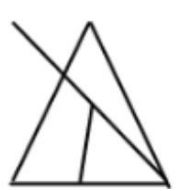
How many straight lines are there in the figure? (Don't consider the extra line if there is another line at 180 degrees)
An unfolded box (cube or cuboid) appeared as shown in the figure, when sheet is folded to form a box. find the number on the face
opposite to 6.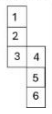
- \(34, \ 68, \ 102, \ 136, \ 170, \ 185\) - which number doesn't follow the series rule?
- Which of the following does NOT belong to the group?
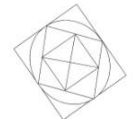
How many triangles are there in the given figure.
- Amazon, Nile, Ganga, Everest - which is not like the others?
Which figure should replace the question mark?
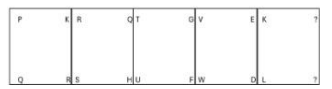
Study the given pattern carefully and select the number that can replace the question mark (?) in it.
15 12 81 17 14 93 15 11 ? Which of the following numbers will replace the question mark (?) in the given series?
4, 11, 21, 37, 62, 109, 171, ?
Important Questions from Miscellaneous
Which gas shields the surface of the earth from ultraviolet radiation from the sun?
Which event is marked as an Intangible Cultural Heritage of Humanity by UNESCO?
Who has been conferred with the rank of the Commander of the Order of the British Empire in 2018?
Who directead the film ‘Bhuvan Shome’?
The book “In my mother’s house” is written by _______



