
When does a parallelogram become a rectangle?
When all four internal angles become right angles.
A parallelogram is a quadrilateral whose opposite sides are parallel and equal, and whose opposite angles are equal; however, its angles are generally oblique and need not measure 90°.
A rectangle is defined as a special parallelogram in which every interior angle is a right angle, so the condition that converts one into the other lies in the angles, not the sides.
In any parallelogram the co-interior (adjacent) angles are supplementary, adding up to 180°.
Therefore, the moment a single interior angle becomes 90°, its neighbour must also be 90°, and by the opposite-angle property all four angles become right angles automatically.
This makes the sides meet perpendicularly and the figure satisfies the rectangle definition exactly.
Making two adjacent sides equal instead produces a rhombus, and perpendicular diagonals likewise describe a rhombus or square, so those options do not define a rectangle.
Unequal boundary sides do not follow the parallelogram rule at all, since opposite sides must stay equal.
Hence, the answer is When all four internal angles become right angles.
Similar Questions
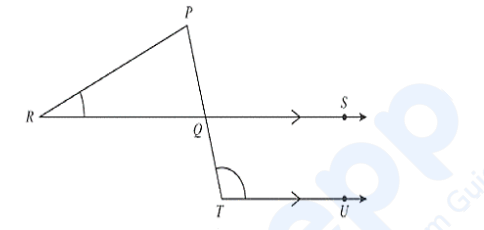
In the following figure, RS ∥ TU. Find the value of ∠PQR − ∠PRQ, if ∠QTU + ∠PRQ = 130° and ∠RPQ = 80°.
- What is the radius of a circle in cm where the central angle of $30^\circ$ intercepts an arc of length 2cm? (take $\pi = \frac{22}{7}$)
Important Questions from Geometry
The sides of a triangle are in the ratio 6 : 4 : 3 and its perimeter is 104 cm. The length of the longest side (in cm) is:
An isosceles right-angled triangle has hypotenuse length as 10 units. What is the area of the triangle (in square units)?
Two circles of radii 16 cm and 4 cm, respectively, touch each other externally at Point A. PQ is the direct common tangent of these circles with centres C1 and C2, respectively. What is the length of PQ?
Let C be a circle with center O and AB be a chord of C such that the length of AB is equal to the radius of C. Let D be any point on the major arc of AB. Find ∠AOB and ∠ADB, respectively.
The centres of two circles are 84 cm apart. If the radii of these two circles are 38 cm and 26 cm, respectively, then which of the following options gives the length (in cm) of a direct common tangent of these two circles?



