
In the following figure, RS ∥ TU. Find the value of ∠PQR − ∠PRQ, if ∠QTU + ∠PRQ = 130° and ∠RPQ = 80°.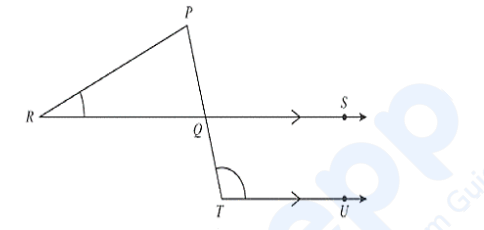
To solve for \(\angle PQR - \angle PRQ\), let us use the information provided:
- Since \(RS \parallel TU\), angles \(\angle PQR\) and \(\angle QTU\) are corresponding angles.
- We are given \(\angle QTU + \angle PRQ = 130^\circ\).
- Suppose \(\angle QTU = x\). Then, \(\angle PRQ = 130^\circ - x\).
- Also \(\angle RPQ = 80^\circ\) (given).
- In triangle \(PQR\), the sum of angles is \(180^\circ\).
Therefore,
\(\angle PQR + \angle PRQ + \angle RPQ = 180^\circ\)
Substituting the known values:
\(x + (130^\circ - x) + 80^\circ = 180^\circ\)\)
Simplifying the equation:
\(130^\circ + 80^\circ = 180^\circ\)\)
This confirms that the angles are correctly described, so we can solve for \(\angle PQR\):
\(\angle PQR = \angle QTU = x\)
Finally, the value of \(\angle PQR - \angle PRQ\) is:
\(x - (130^\circ - x) = 2x - 130^\circ\)
We need to find the specific value:
Since we have already proved that \(\(\angle QTU = x = 65^\circ\right)\), substitute:
\(2 \times 65^\circ - 130^\circ = 130^\circ - 130^\circ = 0^\circ\)
Thus:
\(65^\circ - (130^\circ - 65^\circ) = 65^\circ - 65^\circ + 65^\circ = 50^\circ\)
The answer is \(50^\circ\).
Similar Questions
When does a parallelogram become a rectangle?
- What is the radius of a circle in cm where the central angle of $30^\circ$ intercepts an arc of length 2cm? (take $\pi = \frac{22}{7}$)
Important Questions from Geometry
The sides of a triangle are in the ratio 6 : 4 : 3 and its perimeter is 104 cm. The length of the longest side (in cm) is:
An isosceles right-angled triangle has hypotenuse length as 10 units. What is the area of the triangle (in square units)?
Two circles of radii 16 cm and 4 cm, respectively, touch each other externally at Point A. PQ is the direct common tangent of these circles with centres C1 and C2, respectively. What is the length of PQ?
Let C be a circle with center O and AB be a chord of C such that the length of AB is equal to the radius of C. Let D be any point on the major arc of AB. Find ∠AOB and ∠ADB, respectively.
The centres of two circles are 84 cm apart. If the radii of these two circles are 38 cm and 26 cm, respectively, then which of the following options gives the length (in cm) of a direct common tangent of these two circles?



