
Circle Radius Calculation: Arc Length & Central Angle
The problem asks for the radius of a circle given the arc length and the central angle subtended by that arc. We are given:
- Arc length ($s$) = 2 cm
- Central angle ($\theta$) = $30^\circ$
- Value of $\pi$ = $\frac{22}{7}$
Convert Angle to Radians
The formula relating arc length, radius, and central angle requires the angle to be in radians. To convert degrees to radians, we use the conversion factor $\frac{\pi}{180^\circ}$.
$ \theta_{\text{rad}} = 30^\circ \times \frac{\pi}{180^\circ} = \frac{30\pi}{180} = \frac{\pi}{6} \text{ radians} $
Arc Length Formula
The formula for the arc length ($s$) of a circle is:
$ s = r \theta_{\text{rad}} $
Where '$r$' is the radius and '$\theta_{\text{rad}}$' is the central angle in radians.
Calculate Radius
Now, we substitute the known values into the formula and solve for the radius ($r$):
$ 2 \text{ cm} = r \times \frac{\pi}{6} $
Rearranging the formula to solve for $r$:
$ r = \frac{2 \text{ cm}}{\frac{\pi}{6}} = \frac{2 \times 6}{\pi} \text{ cm} = \frac{12}{\pi} \text{ cm} $
Substitute Pi Value
Using the given value $\pi = \frac{22}{7}$:
$ r = \frac{12}{\frac{22}{7}} \text{ cm} = 12 \times \frac{7}{22} \text{ cm} = \frac{84}{22} \text{ cm} $
Simplify and Final Answer
Simplify the fraction and convert it to a decimal:
$ r = \frac{84 \div 2}{22 \div 2} \text{ cm} = \frac{42}{11} \text{ cm} $
$ r \approx 3.818181... \text{ cm} $
Rounding to two decimal places, the radius is approximately 3.82 cm.
Similar Questions
When does a parallelogram become a rectangle?
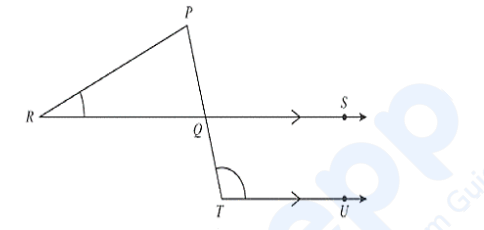
In the following figure, RS ∥ TU. Find the value of ∠PQR − ∠PRQ, if ∠QTU + ∠PRQ = 130° and ∠RPQ = 80°.
Important Questions from Geometry
The sides of a triangle are in the ratio 6 : 4 : 3 and its perimeter is 104 cm. The length of the longest side (in cm) is:
An isosceles right-angled triangle has hypotenuse length as 10 units. What is the area of the triangle (in square units)?
Two circles of radii 16 cm and 4 cm, respectively, touch each other externally at Point A. PQ is the direct common tangent of these circles with centres C1 and C2, respectively. What is the length of PQ?
Let C be a circle with center O and AB be a chord of C such that the length of AB is equal to the radius of C. Let D be any point on the major arc of AB. Find ∠AOB and ∠ADB, respectively.
The centres of two circles are 84 cm apart. If the radii of these two circles are 38 cm and 26 cm, respectively, then which of the following options gives the length (in cm) of a direct common tangent of these two circles?



