
What will happen to the output voltage in a series regulator, when temperature increases?
Series Regulator Output Voltage Temperature Effect
In a typical series regulator circuit, the output voltage regulation often relies on a reference voltage element, commonly a Zener diode or a bandgap reference. The behavior of these components under temperature changes directly influences the output voltage.
Component Behavior with Temperature
Many semiconductor components exhibit changes in their electrical characteristics as temperature varies. Specifically:
- Zener Diodes: Most Zener diodes have a positive temperature coefficient. This means that as the temperature increases, the Zener breakdown voltage also tends to increase slightly.
- Transistors: The VBE (base-emitter voltage) of transistors used in the regulator's pass element also decreases with increasing temperature, but the primary factor affecting output voltage stability in many simple designs is the reference voltage.
Impact on Output Voltage
Since the series regulator aims to maintain a constant output voltage (Vout) based on a reference voltage (Vref) and usually some feedback network, an increase in Vref due to higher temperature will directly lead to an increase in Vout.
For example, in a simple Zener reference circuit followed by a pass transistor, if the Zener voltage increases with temperature, the base voltage of the pass transistor increases, causing the collector voltage (output voltage) to increase.
Conclusion
Therefore, when the temperature increases in a series regulator, the output voltage tends to increase due to the temperature dependency of the reference voltage element.
Final Answer: The final answer is Option BSimilar Questions
Identify the common element present inside all voltage regulator ICs from the given options.
In an Op-Amp voltage regulator, the regulating element is connected:
Important Questions from Voltage Regulators
Identify the common element present inside all voltage regulator ICs from the given options.
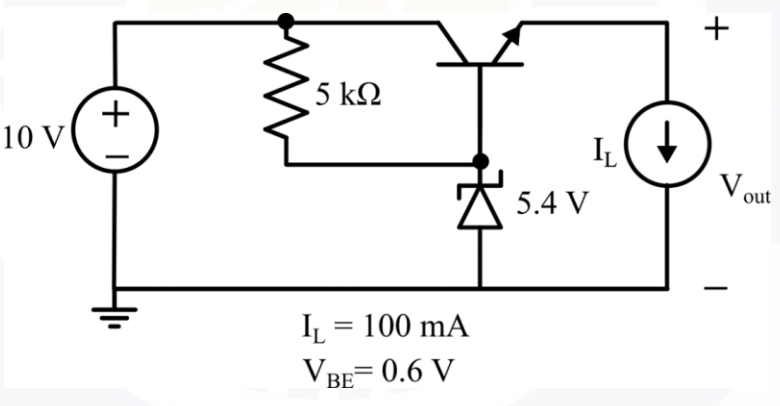
In the linear regulator circuit shown, the base to emitter voltage $V_{BE}$ of the BJT is 0.6 V. The Zener diode clamps the base voltage to 5.4 V. Ignore the biasing current of the Zener diode and BJT.
The maximum possible efficiency of the regulator circuit is ___________ %
(Round off to one decimal place)
In an Op-Amp voltage regulator, the regulating element is connected:



