
Question
In the linear regulator circuit shown, the base to emitter voltage $V_{BE}$ of the BJT is 0.6 V. The Zener diode clamps the base voltage to 5.4 V. Ignore the biasing current of the Zener diode and BJT. The maximum possible efficiency of the regulator circuit is ___________ % (Round off to one decimal place)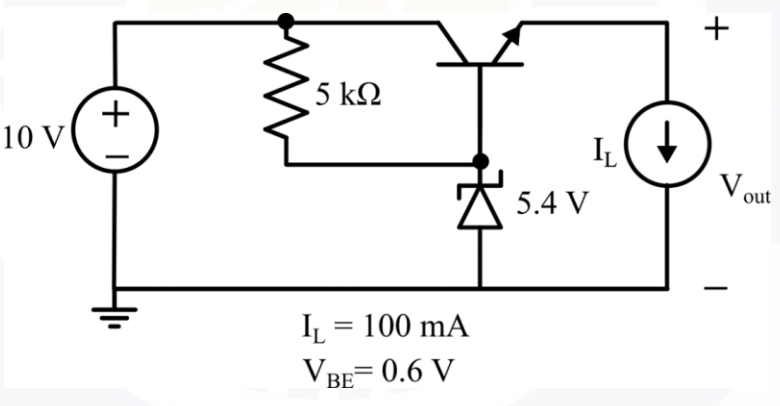
- In the given regulator circuit, the Zener diode sets the base voltage \(V_B\) at 5.4 V.
- The base-emitter voltage \(V_{BE}\) of the BJT is 0.6 V.
- Thus, the output voltage \(V_{out}\) is given by: \[ V_{out} = V_B - V_{BE} = 5.4\,\text{V} - 0.6\,\text{V} = 4.8\,\text{V} \]
- The input voltage \(V_{in}\) to the circuit is 10 V.
- The load current \(I_L\) is 100 mA.
- The power delivered to the load \(P_{out}\) is: \[ P_{out} = V_{out} \times I_L = 4.8\,\text{V} \times 0.1\,\text{A} = 0.48\,\text{W} \]
- The power drawn from the source \(P_{in}\) is: \[ P_{in} = V_{in} \times I_L = 10\,\text{V} \times 0.1\,\text{A} = 1\,\text{W} \]
- The efficiency \(\eta\) of the regulator is given by: \[ \eta = \left(\frac{P_{out}}{P_{in}}\right) \times 100 = \left(\frac{0.48}{1}\right) \times 100 = 48\% \]
The maximum possible efficiency of the regulator circuit is 48.0%, which lies within the given range 47.5% to 48%.
Was this answer helpful?
Important Questions from Voltage Regulators
Identify the common element present inside all voltage regulator ICs from the given options.
In an Op-Amp voltage regulator, the regulating element is connected:
What will happen to the output voltage in a series regulator, when temperature increases?
Need Expert Advice?


