
Identify the common element present inside all voltage regulator ICs from the given options.
Series pass transistor
Understanding Common Components in Voltage Regulator ICs
Voltage regulator ICs are fundamental components in electronics used to maintain a stable output voltage despite fluctuations in input voltage or changes in the load current. They are crucial for ensuring that sensitive electronic circuits receive a steady and reliable power supply.
The question asks to identify an element that is commonly found inside all voltage regulator ICs from the given options. Let's examine each option:
- Load resistor: A load resistor represents the device or circuit that the voltage regulator is powering. It is always connected externally to the output of the regulator, not located inside the IC itself.
- Filter capacitor: Filter capacitors are typically used at the input of a voltage regulator to smooth out the rectified AC voltage and at the output to improve transient response and stability. While some complex regulator ICs might integrate small capacitors, larger filter capacitors, especially those used for input ripple reduction, are almost always connected externally. It is not a universally common *internal* element across all types of regulator ICs in the same way functional core components are.
- Transformer: A transformer is used to step down or step up AC voltage from the power line before it is rectified and regulated. Transformers operate on AC power and are always large, discrete components located externally to the voltage regulator IC.
- Series pass transistor: This is a key functional component found inside linear voltage regulator ICs (like the popular 78xx series, LM317, etc.). In a linear regulator, the series pass transistor (or a similar active element like a MOSFET) is connected in series with the load and acts like a variable resistor. A control circuit within the IC adjusts the resistance of this transistor to drop the excess input voltage, thereby keeping the output voltage constant. While switching regulators operate differently, the concept of an active element controlling the current path is central to regulation, and among the given options, the series pass transistor is the most appropriate answer representing a common *internal* functional block in widely used voltage regulator ICs.
Based on the analysis of the options, the series pass transistor is the element commonly found inside a major type of voltage regulator IC, responsible for controlling the output voltage.
Revision Table: Components and Their Location
| Component | Typical Location | Is it commonly found INSIDE voltage regulator ICs? |
|---|---|---|
| Load resistor | External (the circuit being powered) | No |
| Filter capacitor | Mostly External (for input filtering, output stability) | Generally No (large ones are external) |
| Transformer | External (part of the power supply before regulation) | No |
| Series pass transistor | Internal (key part of linear regulators) | Yes (in linear IC regulators) |
Additional Information on Voltage Regulator ICs
Voltage regulator ICs come in various types, with linear and switching regulators being the most common. The question specifically refers to elements commonly found inside. Let's look closer:
- Linear Voltage Regulators: These ICs use an active component, typically a series pass transistor (or MOSFET), operating in its linear (active) region to drop the excess voltage. They are simple and have low noise but are less efficient, converting the dropped voltage into heat. The series pass transistor is central to their operation and is integrated into the IC.
- Switching Voltage Regulators: These ICs are more complex and use a switch (like a MOSFET or transistor) that is rapidly switched on and off. They often require external inductors and capacitors for energy storage and filtering. While they don't use a "series pass transistor" in the same way linear regulators do, they have internal switching transistors. However, among the options provided, "series pass transistor" is the term associated with a fundamental internal component of a common IC regulator type (linear).
Considering the options given, the series pass transistor is the element that is a core, integrated functional part of common voltage regulator ICs (linear type), making it the correct answer in this context.
Similar Questions
In an Op-Amp voltage regulator, the regulating element is connected:
What will happen to the output voltage in a series regulator, when temperature increases?
Important Questions from Voltage Regulators
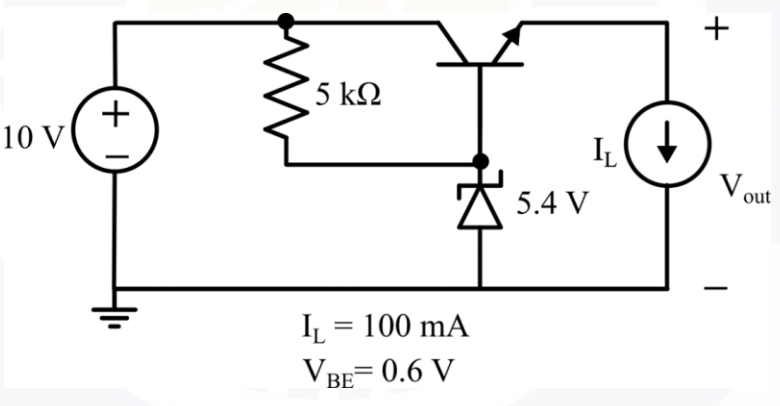
In the linear regulator circuit shown, the base to emitter voltage $V_{BE}$ of the BJT is 0.6 V. The Zener diode clamps the base voltage to 5.4 V. Ignore the biasing current of the Zener diode and BJT.
The maximum possible efficiency of the regulator circuit is ___________ %
(Round off to one decimal place)
In an Op-Amp voltage regulator, the regulating element is connected:
What will happen to the output voltage in a series regulator, when temperature increases?



