
In an Op-Amp voltage regulator, the regulating element is connected:
Regulating Element Placement in Op-Amp Voltage Regulators
In an Op-Amp voltage regulator circuit, the primary goal is to maintain a stable output voltage delivered to the load, regardless of changes in input voltage or load current. The Op-Amp compares a fraction of the output voltage with a stable reference voltage (often a Zener diode) and adjusts a control element accordingly.
Series Connection for Voltage Control
The 'regulating element' is typically a transistor (like a BJT or MOSFET) that acts as a variable resistor or voltage source. To effectively control the voltage reaching the load, this element must be placed directly in the path of the current flowing to the load.
- Placing the regulating element in series with the load allows it to adjust its resistance or voltage drop to compensate for fluctuations, thereby ensuring the voltage across the load remains constant.
- Connecting it across the Zener diode or across the load would not allow it to regulate the voltage delivered to the load effectively.
- Connecting it in series with the Zener diode would affect the reference voltage, not the output voltage regulation.
Therefore, the regulating element is fundamentally connected in series with the load it is intended to regulate.
Similar Questions
Identify the common element present inside all voltage regulator ICs from the given options.
What will happen to the output voltage in a series regulator, when temperature increases?
Important Questions from Voltage Regulators
Identify the common element present inside all voltage regulator ICs from the given options.
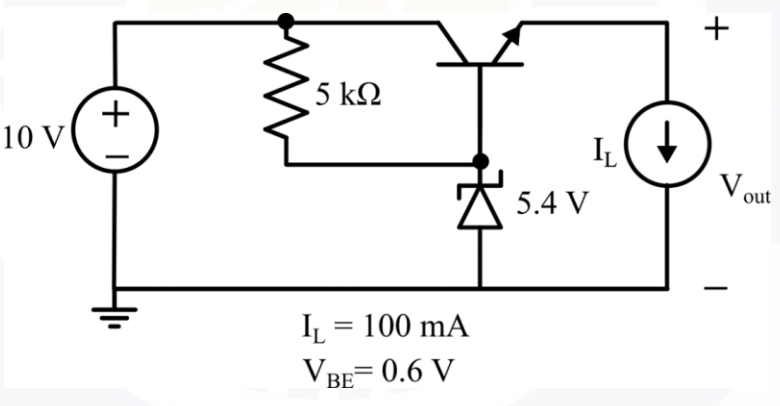
In the linear regulator circuit shown, the base to emitter voltage $V_{BE}$ of the BJT is 0.6 V. The Zener diode clamps the base voltage to 5.4 V. Ignore the biasing current of the Zener diode and BJT.
The maximum possible efficiency of the regulator circuit is ___________ %
(Round off to one decimal place)
What will happen to the output voltage in a series regulator, when temperature increases?



