
What is the correct sequence of increasing reactivity of the following compounds towards nucleophilic addition reaction?
(A) Ethanal
(B) Propanone
(C) Propanal
(D) Butanone
Choose the correct answer from the options given below:
This question asks to determine the correct order of increasing reactivity of four carbonyl compounds towards nucleophilic addition reactions. The compounds are Ethanal (A), Propanone (B), Propanal (C), and Butanone (D).
Understanding Nucleophilic Addition Reactivity
The reactivity of aldehydes and ketones in nucleophilic addition reactions depends on two primary factors:
- Electrophilicity of the Carbonyl Carbon: The carbon atom in the carbonyl group ($C=O$) is partially positive ($\delta+$) due to the electronegativity of oxygen. Electron-donating groups attached to the carbonyl carbon reduce this positive charge, making it less susceptible to attack by nucleophiles (electron-rich species).
- Steric Hindrance: Large or bulky groups attached to the carbonyl carbon hinder the approach of the nucleophile, slowing down the reaction rate.
Analyzing the Compounds
Let's analyze each compound based on these factors:
- (A) Ethanal ($CH_3CHO$): Has one hydrogen atom and one methyl group ($CH_3-$) attached to the carbonyl. The methyl group is electron-donating and offers moderate steric hindrance.
- (C) Propanal ($CH_3CH_2CHO$): Has one hydrogen atom and one ethyl group ($CH_3CH_2-$) attached to the carbonyl. The ethyl group is more electron-donating and offers more steric hindrance than the methyl group.
- (B) Propanone ($CH_3COCH_3$): Has two methyl groups ($CH_3-$) attached to the carbonyl. Compared to aldehydes, ketones have two electron-donating alkyl groups, reducing electrophilicity and increasing steric hindrance.
- (D) Butanone ($CH_3COCH_2CH_3$): Has one methyl group ($CH_3-$) and one ethyl group ($CH_3CH_2-$) attached to the carbonyl. This combination results in greater electron donation and steric hindrance compared to propanone.
Comparing Reactivity: Aldehydes vs. Ketones
Generally, aldehydes are more reactive than ketones towards nucleophilic addition because:
- Aldehydes have one hydrogen atom attached to the carbonyl, which is less electron-donating and sterically less hindering than the alkyl groups found in ketones.
Comparing Reactivity within Aldehydes
- Ethanal ($CH_3CHO$) has a methyl group.
- Propanal ($CH_3CH_2CHO$) has an ethyl group.
- Since the ethyl group ($CH_3CH_2-$) is more electron-donating and sterically bulkier than the methyl group ($CH_3-$), Propanal is less reactive than Ethanal.
- Reactivity order: Ethanal > Propanal
Comparing Reactivity within Ketones
- Propanone ($CH_3COCH_3$) has two methyl groups.
- Butanone ($CH_3COCH_2CH_3$) has one methyl and one ethyl group.
- The ethyl group is more electron-donating and sterically hindering than the methyl group. Therefore, the combination of methyl and ethyl groups in Butanone makes it less reactive than Propanone, which has two methyl groups.
- Reactivity order: Propanone > Butanone
Determining the Overall Reactivity Sequence
Combining the comparisons:
- Aldehydes are more reactive than ketones.
- Within aldehydes, Ethanal is more reactive than Propanal.
- Within ketones, Propanone is more reactive than Butanone.
Therefore, the order of increasing reactivity is:
- Butanone (D) - Least reactive
- Propanone (B)
- Propanal (C)
- Ethanal (A) - Most reactive
The correct sequence is (D), (B), (C), (A).
Important Questions from Aldehydes, Ketones and Carboxylic Acids
Phenol is brominated in solvent CS₂ at low temperature. The product formed are:
What is not true regarding compound [B]?
(A) They are higher boiling liquids than aldehydes and ketones due to extensive H bonding
(B) They are soluble in Benzene
(C) They produce alkane when heated with soda lime
(D) Produces CO₂ when treated with NaHCO₃
Choose the correct answer from the options given below:
Which of the following is the correct statement for hybridization of C-atom and number of π bonds in the Carbonyl group?
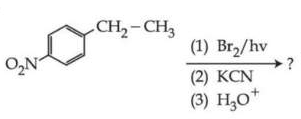
What is the product formed in the following reaction sequence?
What will be the product formed when cyclohexanone undergoes Aldol condensation?


