
Two shuttle looms (A and B), running at same picks per minute, have same mass of sley and associated system for beat up. The crank radius ($r$) and the eccentricity ratio ($e$) of the looms are
$r_A = 10 \text{ cm}; e_A = 0.5; r_B = 6 \text{ cm}; e_B = 0.4$
The ratio of the beat up force of loom A to that of loom B (rounded off to 1 decimal place) is ________
The problem asks to find the ratio of beat-up force between two shuttle looms, Loom A and Loom B, given their respective crank radii ($r$) and eccentricity ratios ($e$). The looms operate at the same picks per minute and have identical sley masses and associated systems.
Shuttle Loom Beat Up Force Ratio
Identifying Key Parameters
- Loom A: Crank radius $r_A = 10 \text{ cm}$, Eccentricity ratio $e_A = 0.5$
- Loom B: Crank radius $r_B = 6 \text{ cm}$, Eccentricity ratio $e_B = 0.4$
- Assumptions: Same picks per minute, same sley mass and system for both looms.
Determining Beat Up Force Relationship
For shuttle looms, the beat-up force ($F$) is influenced by several factors including the mass of the sley, the speed of operation, the crank radius ($r$), and the mechanism's geometry, often characterized by the eccentricity ratio ($e$). A common approximation relating these factors for the beat-up force is proportional to the product of the crank radius and a term involving the eccentricity ratio:
$F \propto r(1+e)$
Since the mass and operating speed are the same for both looms, the ratio of their beat-up forces will depend only on the variation in $r$ and $e$.
Calculating the Ratio of Forces
The ratio of the beat-up force of Loom A to Loom B ($F_A / F_B$) can be expressed as:
$ \frac{F_A}{F_B} = \frac{r_A(1+e_A)}{r_B(1+e_B)} $
Substitute the given values:
$ \frac{F_A}{F_B} = \frac{10 \text{ cm} \times (1 + 0.5)}{6 \text{ cm} \times (1 + 0.4)} $
Simplify the expression:
$ \frac{F_A}{F_B} = \frac{10 \times 1.5}{6 \times 1.4} $
$ \frac{F_A}{F_B} = \frac{15}{8.4} $
Final Beat Up Force Ratio
Perform the division:
$ \frac{15}{8.4} \approx 1.7857 $
Rounding the result to 1 decimal place gives 1.8.
This value (1.8) lies within the provided range of 1.7 to 1.9.
Important Questions from FABR Loom Mechanisms Beating-up
- Amongst the following, producing a dense fabric in a weaving machine require(s)
- At front centre ($0^\circ$) and at back centre ($180^\circ$) of a shuttle loom,
- The force exerted by the reed on the cloth-fell at the instant of beat-up (weaving resistance) depends on
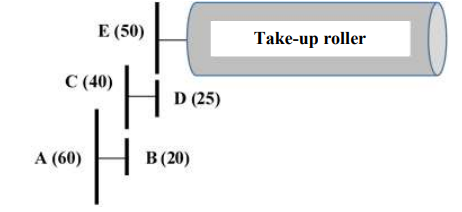
A take-up motion is shown below. The number of teeth on gear A, B, C, D and E are 60, 20, 40, 25 and 50, respectively. The circumference of the take-up roller is 40 cm. If one tooth is broken on gear B, then the wavelength (cm) of the fault in fabric (in integer) is _________________.
- Diamond bars appear in woven fabric due to


