
Sley Motion Analysis at Extreme Positions
The question asks about the sley velocities and accelerations at the front centre ($0^\circ$) and back centre ($180^\circ$) of a shuttle loom. These represent the endpoints of the sley's reciprocating motion.
Velocity Comparison
At the extreme ends of its travel (front centre and back centre), the sley momentarily stops before reversing direction. In simplified models of such mechanisms, like simple harmonic motion, the velocity at these extreme points is zero.
- Velocity at front centre ($v_{0^\circ}$) = 0
- Velocity at back centre ($v_{180^\circ}$) = 0
Therefore, the sley velocities are the same at both positions.
Acceleration Comparison
Acceleration is the rate of change of velocity. While the velocity is zero at both extreme points, the sley must change direction rapidly at these points.
- At the front centre ($0^\circ$), the sley stops its forward motion and begins moving backward. This requires a significant change in velocity, indicating maximum acceleration (or deceleration, depending on perspective). Let's denote this as $a_{0^\circ}$.
- At the back centre ($180^\circ$), the sley stops its backward motion and begins moving forward. This also requires a significant change in velocity, indicating maximum acceleration (or deceleration). Let's denote this as $a_{180^\circ}$.
Using a simple harmonic motion model $x(t) = A \cos(\omega t)$, velocity is $v(t) = -A \omega \sin(\omega t)$ and acceleration is $a(t) = -A \omega^2 \cos(\omega t)$.
- At $0^\circ$ ($\omega t = 0$), $v=0$ and $a = -A \omega^2$.
- At $180^\circ$ ($\omega t = \pi$), $v=0$ and $a = -A \omega^2 \cos(\pi) = A \omega^2$.
The velocities are the same (zero), but the accelerations have the same magnitude ($A \omega^2$) but opposite directions ($-A \omega^2$ and $A \omega^2$). Thus, the accelerations are different.
Conclusion
Based on the analysis of motion at the extreme points:
- Sley velocities are the same (zero).
- Sley accelerations are different (equal magnitude, opposite direction).
This corresponds to Option 1.
Important Questions from FABR Loom Mechanisms Beating-up
- Amongst the following, producing a dense fabric in a weaving machine require(s)
Two shuttle looms (A and B), running at same picks per minute, have same mass of sley and associated system for beat up. The crank radius ($r$) and the eccentricity ratio ($e$) of the looms are
$r_A = 10 \text{ cm}; e_A = 0.5; r_B = 6 \text{ cm}; e_B = 0.4$
The ratio of the beat up force of loom A to that of loom B (rounded off to 1 decimal place) is ________- The force exerted by the reed on the cloth-fell at the instant of beat-up (weaving resistance) depends on
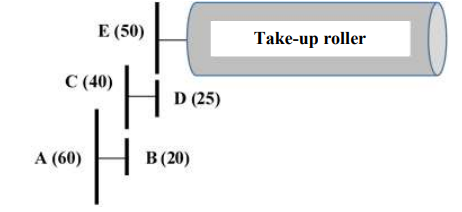
A take-up motion is shown below. The number of teeth on gear A, B, C, D and E are 60, 20, 40, 25 and 50, respectively. The circumference of the take-up roller is 40 cm. If one tooth is broken on gear B, then the wavelength (cm) of the fault in fabric (in integer) is _________________.
- Diamond bars appear in woven fabric due to


