
Weaving Resistance Factors Explained
The force exerted by the reed on the cloth-fell during the beat-up process, often termed weaving resistance, is influenced by several material and geometric properties. Understanding these factors is crucial for optimizing the weaving process and ensuring fabric quality.
Key Factors Influencing Reed Force
- Free length of warp yarn: A longer free length of warp yarn between the back rest and the reed allows for more elongation and bending before the yarn encounters the cloth fell. This increased flexibility can affect the total resistance force experienced during beat-up.
- Elastic modulus of warp yarn: The elastic modulus quantifies a material's stiffness or resistance to elastic deformation. Warp yarns with a higher elastic modulus are stiffer and stretch less under tension. This higher stiffness contributes to increased weaving resistance as the reed pushes the weft yarn into place.
- Elastic modulus of loom-state fabric: The loom-state fabric already possesses structural integrity. Its elastic modulus indicates how resistant the fabric structure itself is to compression and deformation. A fabric with a higher elastic modulus (i.e., a stiffer fabric) will offer greater resistance to the force applied by the reed.
Therefore, the force exerted by the reed depends on the combination of the warp yarn's properties (length and modulus) and the resistance offered by the partially formed fabric (loom-state fabric modulus).
Important Questions from FABR Loom Mechanisms Beating-up
- Amongst the following, producing a dense fabric in a weaving machine require(s)
Two shuttle looms (A and B), running at same picks per minute, have same mass of sley and associated system for beat up. The crank radius ($r$) and the eccentricity ratio ($e$) of the looms are
$r_A = 10 \text{ cm}; e_A = 0.5; r_B = 6 \text{ cm}; e_B = 0.4$
The ratio of the beat up force of loom A to that of loom B (rounded off to 1 decimal place) is ________- At front centre ($0^\circ$) and at back centre ($180^\circ$) of a shuttle loom,
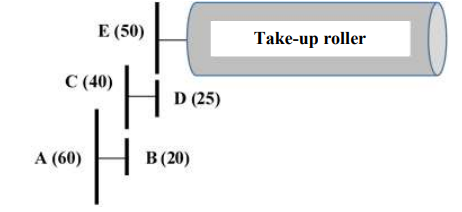
A take-up motion is shown below. The number of teeth on gear A, B, C, D and E are 60, 20, 40, 25 and 50, respectively. The circumference of the take-up roller is 40 cm. If one tooth is broken on gear B, then the wavelength (cm) of the fault in fabric (in integer) is _________________.
- Diamond bars appear in woven fabric due to


