
To produce a dense fabric in a weaving machine, several factors influence the quality and tightness of the weave. Let us go through the options provided and identify which contribute to creating a dense fabric:
- Higher Sley Eccentricity:
Sley eccentricity is related to the adjustment of the timing of the beat of the sley, which is crucial for compacting the fabric tightly. A higher sley eccentricity means that the reed pushes the weft threads more closely together, resulting in a denser fabric. Hence, this option is correct.
- Higher Basic Warp Tension:
Maintaining higher tension in the warp threads ensures that the threads are straight and even, leading to a tight weave. This contributes to the production of a dense fabric because it helps the reed push the weft thread uniformly and closely into the weave. Hence, this option is correct.
- Lower Cloth Fell Displacement at the Time of Beat Up:
A lower displacement would not contribute to compacting the fabric, because less motion would result in looser packing of the weft threads. Thus, this option does not help in producing a denser fabric.
- Stronger Warp Yarn:
Using stronger warp yarns helps maintain high tension without the risk of yarn breakage. This ensures a stable and consistent structure in the warp, which contributes to the production of dense fabric. Therefore, stronger warp yarns are necessary for producing a dense fabric. Hence, this option is correct.
In conclusion, the correct options for producing a dense fabric in a weaving machine are higher sley eccentricity, higher basic warp tension, and stronger warp yarn.
Important Questions from FABR Loom Mechanisms Beating-up
Two shuttle looms (A and B), running at same picks per minute, have same mass of sley and associated system for beat up. The crank radius ($r$) and the eccentricity ratio ($e$) of the looms are
$r_A = 10 \text{ cm}; e_A = 0.5; r_B = 6 \text{ cm}; e_B = 0.4$
The ratio of the beat up force of loom A to that of loom B (rounded off to 1 decimal place) is ________- At front centre ($0^\circ$) and at back centre ($180^\circ$) of a shuttle loom,
- The force exerted by the reed on the cloth-fell at the instant of beat-up (weaving resistance) depends on
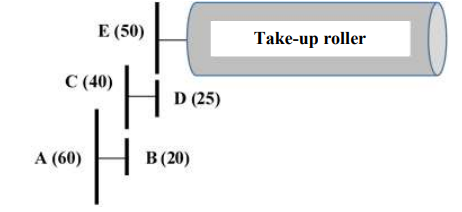
A take-up motion is shown below. The number of teeth on gear A, B, C, D and E are 60, 20, 40, 25 and 50, respectively. The circumference of the take-up roller is 40 cm. If one tooth is broken on gear B, then the wavelength (cm) of the fault in fabric (in integer) is _________________.
- Diamond bars appear in woven fabric due to


