Identifying Diamond Bar Defects in Woven Fabric
Diamond bars, also known as barré defects, are noticeable horizontal bands or patterns that appear across the width of woven fabric. Identifying the cause is crucial for quality control in textile manufacturing.
Analyzing Defect Causes
The appearance of diamond bars is linked to irregularities in the yarns used during weaving. Let's examine the options:
- Faulty loom parts: While faulty loom parts can cause various defects, they typically result in more random or lengthwise distortions, not the distinct, periodic horizontal pattern of diamond bars.
- Excessive warp irregularity: Irregularities in the warp yarns (running lengthwise) usually lead to defects visible along the length of the fabric, such as streaks or variations in width, not horizontal bars.
- Periodic fault in warp yarn: Similar to general warp irregularity, a periodic fault in the warp yarn would manifest as a lengthwise repeating defect, impacting the fabric's structure along its length, not its width.
- Periodic fault in weft yarn: This is the direct cause of diamond bars. A periodic fault means a specific issue (like variations in yarn count, tension, twist, or thickness) repeats at regular intervals in the weft yarn (which runs horizontally). This regularity in the weft causes the characteristic horizontal banding or diamond pattern across the fabric's width.
Conclusion
A periodic fault in weft yarn directly leads to the formation of diamond bars due to the regular, repeating nature of the defect across the fabric's width.
Important Questions from FABR Loom Mechanisms Beating-up
- Amongst the following, producing a dense fabric in a weaving machine require(s)
Two shuttle looms (A and B), running at same picks per minute, have same mass of sley and associated system for beat up. The crank radius ($r$) and the eccentricity ratio ($e$) of the looms are
$r_A = 10 \text{ cm}; e_A = 0.5; r_B = 6 \text{ cm}; e_B = 0.4$
The ratio of the beat up force of loom A to that of loom B (rounded off to 1 decimal place) is ________- At front centre ($0^\circ$) and at back centre ($180^\circ$) of a shuttle loom,
- The force exerted by the reed on the cloth-fell at the instant of beat-up (weaving resistance) depends on
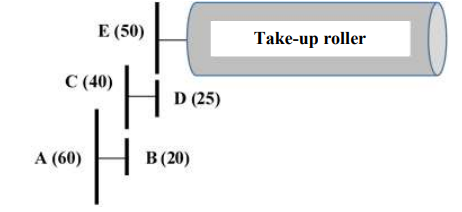
A take-up motion is shown below. The number of teeth on gear A, B, C, D and E are 60, 20, 40, 25 and 50, respectively. The circumference of the take-up roller is 40 cm. If one tooth is broken on gear B, then the wavelength (cm) of the fault in fabric (in integer) is _________________.