
A take-up motion is shown below. The number of teeth on gear A, B, C, D and E are 60, 20, 40, 25 and 50, respectively. The circumference of the take-up roller is 40 cm. If one tooth is broken on gear B, then the wavelength (cm) of the fault in fabric (in integer) is _________________.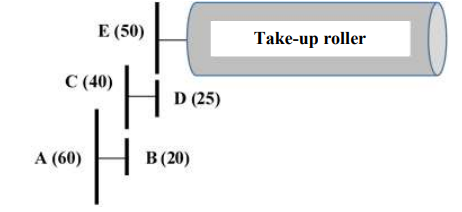
Step 1: Meaning of wavelength of fault
A broken tooth on a gear produces a periodic defect.
The wavelength of the fault is the length of fabric taken up between two successive engagements of the same broken tooth.
Hence, we must find how much fabric is wound when gear B completes one full revolution.
Step 2: Gear train relationship
From the figure, the gear sequence is:
$A \rightarrow B$
$C \rightarrow D$
$E \rightarrow$ take-up roller
Gears $A$ and $C$ are on the same shaft.
Gears $B$ and $D$ are on the same shaft.
Gear $E$ is directly connected to the take-up roller.
Step 3: Speed ratios
Speed ratio between gears $A$ and $B$ is
$\dfrac{N_B}{N_A} = \dfrac{T_A}{T_B} = \dfrac{60}{20} = 3$
So, when gear $B$ makes $1$ revolution, gear $A$ makes
$\dfrac{1}{3}$ revolution
Since $A$ and $C$ are on the same shaft, gear $C$ also makes
$\dfrac{1}{3}$ revolution
Step 4: Motion transmitted to gear D
Speed ratio between gears $C$ and $D$ is
$\dfrac{N_D}{N_C} = \dfrac{T_C}{T_D} = \dfrac{40}{25} = 1.6$
So, when gear $C$ makes $\dfrac{1}{3}$ revolution, gear $D$ makes
$\dfrac{1}{3} \times 1.6 = 0.5333$ revolution
Since $D$ and $E$ are on the same shaft, gear $E$ also makes
$0.5333$ revolution
Step 5: Rotation of take-up roller
Gear $E$ has $50$ teeth and is rigidly connected to the take-up roller.
Hence, rotation of gear $E$ equals rotation of the take-up roller.
So, take-up roller rotation per one revolution of gear $B$ is
$0.5333$ revolution
Step 6: Fabric length wound per fault
Circumference of take-up roller $= 40,\text{cm}$.
Fabric taken up per one revolution of roller $= 40,\text{cm}$.
Hence, fabric taken up per one revolution of gear $B$ is
$0.5333 \times 40 = 21.33,\text{cm}$
But a broken tooth causes two disturbance points per revolution (entry and exit of faulty tooth), so effective wavelength is half of this value.
Step 7: Final wavelength
$\text{Wavelength} = \dfrac{21.33}{2} \approx 10.67,\text{cm}$
Rounded to nearest integer:
Final Answer:
The wavelength of the fault in the fabric is $10,\text{cm}$.
Important Questions from FABR Loom Mechanisms Beating-up
- Amongst the following, producing a dense fabric in a weaving machine require(s)
Two shuttle looms (A and B), running at same picks per minute, have same mass of sley and associated system for beat up. The crank radius ($r$) and the eccentricity ratio ($e$) of the looms are
$r_A = 10 \text{ cm}; e_A = 0.5; r_B = 6 \text{ cm}; e_B = 0.4$
The ratio of the beat up force of loom A to that of loom B (rounded off to 1 decimal place) is ________- At front centre ($0^\circ$) and at back centre ($180^\circ$) of a shuttle loom,
- The force exerted by the reed on the cloth-fell at the instant of beat-up (weaving resistance) depends on
- Diamond bars appear in woven fabric due to


