
Two circles touch each other externally. The radius of the first circle with centre O is 6 cm. The radius of the second circle with centre P is 3 cm. Find the length of their common tangent AB.
6√2 cm
Understanding the Problem: Common Tangent of Externally Touching Circles
The question asks for the length of the common tangent to two circles that touch each other externally. We are given the radius of the first circle (6 cm) and the radius of the second circle (3 cm).
Key Concepts for Solving Common Tangent Problems
When two circles touch externally, the distance between their centers is equal to the sum of their radii. A common tangent is a line segment that is tangent to both circles.
For a direct common tangent (like AB in this problem, assuming A and B are on the same side of the line connecting centers), we can use geometry or a specific formula to find its length.
Method 1: Using Geometric Construction and Pythagoras Theorem
Let the center of the first circle be O with radius \(R_1 = 6\) cm. Let the center of the second circle be P with radius \(R_2 = 3\) cm. The circles touch externally, so the distance between their centers is \(OP = R_1 + R_2 = 6 + 3 = 9\) cm.
Let the common tangent touch the first circle at A and the second circle at B. OA is perpendicular to AB, and PB is perpendicular to AB. OA is the radius \(R_1\), and PB is the radius \(R_2\).
To find the length of AB, draw a line through P parallel to AB, intersecting OA at point C.
- ABPC forms a rectangle. Thus, AB = PC and AC = PB = \(R_2 = 3\) cm.
- The line segment OC is part of the radius OA. Its length is \(OC = OA - AC = R_1 - R_2 = 6 - 3 = 3\) cm.
- Triangle OCP is a right-angled triangle with the right angle at C (since PC is parallel to AB, which is perpendicular to OA).
- The hypotenuse OP is the distance between the centers, which is 9 cm.
Now we can use the Pythagoras theorem in triangle OCP:
\[OP^2 = OC^2 + PC^2\]
Substitute the values:
\[9^2 = 3^2 + PC^2\]
\[81 = 9 + PC^2\]
\[PC^2 = 81 - 9\]
\[PC^2 = 72\]
\[PC = \sqrt{72}\]
To simplify \(\sqrt{72}\), we find the largest perfect square factor of 72. \(72 = 36 \times 2\). So:
\[\sqrt{72} = \sqrt{36 \times 2} = \sqrt{36} \times \sqrt{2} = 6\sqrt{2}\]
Since AB = PC, the length of the common tangent AB is \(6\sqrt{2}\) cm.
Method 2: Using the Direct Formula for Common Tangent Length
The length of the direct common tangent (L) between two circles with radii \(R_1\) and \(R_2\) and the distance between their centers (d) is given by the formula:
\[L = \sqrt{d^2 - (R_1 - R_2)^2}\]
In this case, the circles touch externally, so the distance between centers \(d = R_1 + R_2\). Substituting this into the formula:
\[L = \sqrt{(R_1 + R_2)^2 - (R_1 - R_2)^2}\]
Expanding the terms inside the square root:
\[(R_1 + R_2)^2 = R_1^2 + 2R_1R_2 + R_2^2\]
\[(R_1 - R_2)^2 = R_1^2 - 2R_1R_2 + R_2^2\]
Subtracting the second from the first:
\[(R_1 + R_2)^2 - (R_1 - R_2)^2 = (R_1^2 + 2R_1R_2 + R_2^2) - (R_1^2 - 2R_1R_2 + R_2^2)\]
\[= R_1^2 + 2R_1R_2 + R_2^2 - R_1^2 + 2R_1R_2 - R_2^2\]
\[= 4R_1R_2\]
So, the formula simplifies to:
\[L = \sqrt{4R_1R_2} = 2\sqrt{R_1R_2}\]
Using this simplified formula with \(R_1 = 6\) cm and \(R_2 = 3\) cm:
\[L = 2\sqrt{6 \times 3}\]
\[L = 2\sqrt{18}\]
\[L = 2\sqrt{9 \times 2}\]
\[L = 2 \times 3\sqrt{2}\]
\[L = 6\sqrt{2}\]
The length of the common tangent AB is \(6\sqrt{2}\) cm.
Comparing Methods
Both methods yield the same result, \(6\sqrt{2}\) cm. The geometric method helps understand the derivation of the formula, while the formula provides a quicker way to solve the problem once understood.
Final Answer Derivation
Using either the Pythagoras theorem with the constructed triangle or the direct formula for the common tangent of externally touching circles, we found the length of the common tangent AB to be \(6\sqrt{2}\) cm.
Revision Table: Circle Tangent Formulas
| Concept | Formula/Relation | Notes |
|---|---|---|
| Distance between centers (externally touching circles) | \(d = R_1 + R_2\) | \(R_1, R_2\) are radii |
| Length of Direct Common Tangent | \(L = \sqrt{d^2 - (R_1 - R_2)^2}\) | d = distance between centers |
| Length of Direct Common Tangent (externally touching circles) | \(L = 2\sqrt{R_1R_2}\) | Special case where \(d = R_1 + R_2\) |
| Radius and Tangent at point of contact | Radius is perpendicular to the tangent | Forms a 90-degree angle |
Additional Information: Types of Common Tangents
Circles can have different types of common tangents depending on their positions relative to each other.
- Direct Common Tangents: These tangents keep both circles on the same side of the tangent line. For two circles touching externally, there are two direct common tangents. Their lengths are equal.
- Transverse Common Tangents: These tangents pass between the two circles, keeping the circles on opposite sides of the tangent line. For two circles touching externally, there is one transverse common tangent.
The length of the transverse common tangent (L_T) between two circles with radii \(R_1\) and \(R_2\) and distance between centers (d) is given by the formula:
\[L_T = \sqrt{d^2 - (R_1 + R_2)^2}\]
However, this formula is only applicable when the circles are separate, not touching externally. If circles touch externally, the distance \(d = R_1 + R_2\), making \(d^2 - (R_1 + R_2)^2 = (R_1+R_2)^2 - (R_1+R_2)^2 = 0\). This indicates that for externally touching circles, the point of contact is the only 'transverse common tangent' line segment, which has zero length in terms of a segment between the tangent points on the circles (the tangent line passes through the point of contact). The problem specified "their common tangent AB", referring to a direct common tangent segment.
Similar Questions
A chord 21 cm long is drawn in a circle of diameter 25 cm. The perpendicular distance of the chord from the centre is:
In a circle with radius 5 cm, a chord is at a distance of 3 cm from the centre. The length of the chord is:
The distance between the centres of two circles is 24 cm. If the radius of the two circles are 4 cm and 8 cm, then what is the sum of the lengths (in cm) of the direct common tangent and the transverse common tangent?
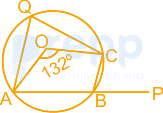
In a circle with centre O, an arc ABC subtends an angle of 132° at the center of the circle. Chord AB is produced to point P. Then ∠CBP is equal to∶
What can be the maximum number of common tangent which can be drawn to two non-intersecting circles?
There are two identical circles of radius 10 cm each. If the length of the direct common tangent is 26 cm, then what is the length (in cm) of the transverse common tangent?
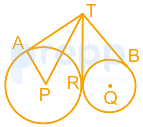
In the figure, two circles with centres P and Q touch externally at R. Tangents AT and BT meet the common tangent TR at T. If AP = 6 cm and PT = 10 cm, then BT =?
AB is a chord in the minor segment of a circle with centre O. C is a point on the minor arc (between A and B). The tangents to the circle at A and B meet at a point P. If ∠ACB = 108°, then ∠APB is equal to:
AB is the chord of a circle such that AB = 10 cm. If the diameter of the circle is 20 cm, then the angle subtended by the chord at the centre is ________.
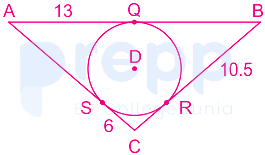
Triangle ABC is circumscribed around circle D. Segments AQ, BR, and SC measure 13, 10.5, and 6 cm, respectively. The perimeter of triangle ABC is:
Important Questions from Circles, Chords and Tangents
A chord 21 cm long is drawn in a circle of diameter 25 cm. The perpendicular distance of the chord from the centre is:
AB is a chord of a circle with centre O and P is any point on the circle. If ∠APB = 112°, then what is the measure of ∠OAB ?
In a circle with radius 5 cm, a chord is at a distance of 3 cm from the centre. The length of the chord is:
The distance between the centres of two circles is 24 cm. If the radius of the two circles are 4 cm and 8 cm, then what is the sum of the lengths (in cm) of the direct common tangent and the transverse common tangent?
An equilateral triangle ABC and a scalene triangle DBC are inscribed in a circle on same side of the arc. what is ∠BDC equal to?



