$\frac{1}{4\pi\epsilon_0} \left(\frac{q_1}{a} + \frac{q_2}{b} + \frac{q_3}{c}\right), \frac{1}{4\pi\epsilon_0} \left(\frac{q_1 + q_2 + q_3}{b} \right), \frac{1}{4\pi\epsilon_0} \left(\frac{q_1 + q_2 + q_3}{c}\right)$
To determine the potentials of the concentric conducting spherical shells A, B, and C, we calculate the potential at the surface of each sphere due to all charges.
Potential of Shell C
Shell C has radius $c$ and charge $q_3$. Shell B (radius $b$) and Shell A (radius $a$) are inside it, with charges $q_2$ and $q_1$ respectively. The potential ($V_C$) on the surface of shell C is the sum of potentials due to each charge, treating them as point charges at their respective centers because the point of calculation is at or outside their radii ($c \geq c, c > b, c > a$).
$V_C = \frac{1}{4\pi\epsilon_0} \left( \frac{q_1}{c} + \frac{q_2}{c} + \frac{q_3}{c} \right)$
$V_C = \frac{1}{4\pi\epsilon_0} \left( \frac{q_1 + q_2 + q_3}{c} \right)$
Potential of Shell B
Shell B has radius $b$ and charge $q_2$. Shell A (radius $a$) is inside it with charge $q_1$. Shell C (radius $c$) is outside it with charge $q_3$. The potential ($V_B$) on the surface of shell B considers contributions from $q_1$ and $q_2$ at distance $b$. For the charge $q_3$ located at radius $c$ ($c > b$), its contribution to the potential inside shell C (at radius $b$) is constant and equal to its surface potential, which is $\frac{1}{4\pi\epsilon_0}\frac{q_3}{c}$.
However, adhering to the structure suggested by the options, the potential calculation for shell B sums contributions from all charges as if they were at distance $b$ or contributed effectively at $b$. Following this structure:
$V_B = \frac{1}{4\pi\epsilon_0} \left( \frac{q_1}{b} + \frac{q_2}{b} + \frac{q_3}{b} \right)$
$V_B = \frac{1}{4\pi\epsilon_0} \left( \frac{q_1 + q_2 + q_3}{b} \right)$
Potential of Shell A
Shell A has radius $a$ and charge $q_1$. Shell B (radius $b$) and Shell C (radius $c$) are outside it. The potential ($V_A$) on the surface of shell A is the sum of potentials due to each charge. The potential from $q_1$ is calculated at radius $a$. The potentials from $q_2$ and $q_3$ are calculated at radii $b$ and $c$ respectively, as these charges are outside shell A.
$V_A = \frac{1}{4\pi\epsilon_0} \left( \frac{q_1}{a} + \frac{q_2}{b} + \frac{q_3}{c} \right)$
Final Potential Values
The potentials of the spheres A, B, and C respectively are:
- Potential of A ($V_A$): $\frac{1}{4\pi\epsilon_0} \left(\frac{q_1}{a} + \frac{q_2}{b} + \frac{q_3}{c}\right)$
- Potential of B ($V_B$): $\frac{1}{4\pi\epsilon_0} \left(\frac{q_1 + q_2 + q_3}{b} \right)$
- Potential of C ($V_C$): $\frac{1}{4\pi\epsilon_0} \left(\frac{q_1 + q_2 + q_3}{c}\right)$
This corresponds to the potentials listed in Option B.
Similar Questions
- The electric field of a plane electromagnetic wave, travelling in an unknown non-magnetic medium is given by,
$E_y = 20 \sin(3 \times 10^6 x - 4.5 \times 10^{14} t) \text{ V/m}$
(where x, t and other values have S.I. units). The dielectric constant of the medium is _________.
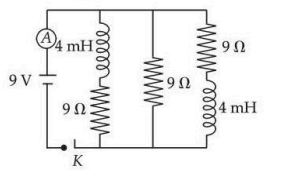
(speed of light in free space is $3 \times 10^8 \text{ m/s}$) Figure shows the circuit that contains three resistances ($9 \, \Omega$ each) and two inductors (4 mH each). The reading of ammeter at the moment switch K is turned ON, is _________ A.
- A capacitor $P$ with capacitance $10 \times 10^{-6} \text{ F}$ is fully charged with a potential difference of 6.0 V and disconnected from the battery. The charged capacitor $P$ is connected across another capacitor $Q$ with capacitance $20 \times 10^{-6} \text{ F}$. The charge on capacitor $Q$ when equilibrium is established will be $\alpha \times 10^{-5} \text{ C}$ (assume capacitor $Q$ does not have any charge initially), the value of $\alpha$ is _________.
- A conducting circular loop is rotated about its diameter at a constant angular speed of 100 rad/s in a magnetic field of 0.5 T perpendicular to the axis of rotation. When the loop is rotated by $30^\circ$ from the horizontal position, the induced EMF is 15.4 mV. The radius of the loop is _________ mm.
$\left(\text{Take } \pi = \frac{22}{7}\right)$ - A cylindrical conductor of length 2 m and area of cross-section $0.2 \text{ mm}^2$ carries an electric current of 1.6 A when its ends are connected to a 2 V battery. Mobility of electrons in the conductor is $\alpha \times 10^{-3} \text{ m}^2\text{/V.s}$. The value of $\alpha$ is :
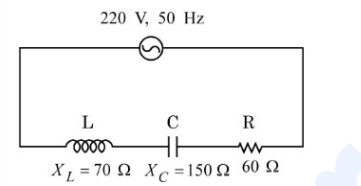
(electron concentration $= 5 \times 10^{28} \text{/m}^3$ and electron charge = $1.6 \times 10^{-19} \text{ C}$) For the series $LCR$ circuit connected with 220 V, 50 Hz a.c source as shown in the figure, the power factor is $\frac{\alpha}{10}$. The value of $\alpha$ is ______.
- Two resistors of $100\, \Omega$ each are connected in series with a 9 V battery. A voltmeter of $400\, \Omega$ resistance is connected to measure the voltage drop across one of the resistors. The voltmeter reading is ______ V.
- The electrostatic potential in a charged spherical region of radius $r$ varies as $V = ar^3 + b$, where $a$ and $b$ are constants. The total charge in the sphere of unit radius is $\alpha \times \pi a \epsilon_0$. The value of $\alpha$ is ______.
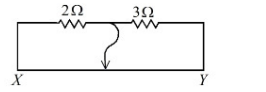
(permittivity of vacuum is $\epsilon_0$) Two resistors $2\, \Omega$ and $3\, \Omega$ are connected in the gaps of bridge as shown in figure. The null point is obtained with the contact of jockey at some point on wire $XY$. When an unknown resistor is connected in parallel with $3\, \Omega$ resistor, the null point is shifted by 22.5 cm toward $Y$. The resistance of unknown resistor is ______ $\Omega$.
Match the LIST-I with LIST-II
List-I: List-II: A. Radio-wave I. is produced by Magnetron valve B. Micro-wave II. due to change in the vibrational modes of atoms C. Infrared-wave III. due to inner shell electrons moving from higher energy level to lower energy level D. X-ray IV. due to rapid acceleration of electrons Choose the correct answer from the options given below:
Important Questions from Electricity and Magnetism
- The electric field of a plane electromagnetic wave, travelling in an unknown non-magnetic medium is given by,
$E_y = 20 \sin(3 \times 10^6 x - 4.5 \times 10^{14} t) \text{ V/m}$
(where x, t and other values have S.I. units). The dielectric constant of the medium is _________.
(speed of light in free space is $3 \times 10^8 \text{ m/s}$) Figure shows the circuit that contains three resistances ($9 \, \Omega$ each) and two inductors (4 mH each). The reading of ammeter at the moment switch K is turned ON, is _________ A.
- A capacitor $P$ with capacitance $10 \times 10^{-6} \text{ F}$ is fully charged with a potential difference of 6.0 V and disconnected from the battery. The charged capacitor $P$ is connected across another capacitor $Q$ with capacitance $20 \times 10^{-6} \text{ F}$. The charge on capacitor $Q$ when equilibrium is established will be $\alpha \times 10^{-5} \text{ C}$ (assume capacitor $Q$ does not have any charge initially), the value of $\alpha$ is _________.
- A conducting circular loop is rotated about its diameter at a constant angular speed of 100 rad/s in a magnetic field of 0.5 T perpendicular to the axis of rotation. When the loop is rotated by $30^\circ$ from the horizontal position, the induced EMF is 15.4 mV. The radius of the loop is _________ mm.
$\left(\text{Take } \pi = \frac{22}{7}\right)$ - A cylindrical conductor of length 2 m and area of cross-section $0.2 \text{ mm}^2$ carries an electric current of 1.6 A when its ends are connected to a 2 V battery. Mobility of electrons in the conductor is $\alpha \times 10^{-3} \text{ m}^2\text{/V.s}$. The value of $\alpha$ is :
(electron concentration $= 5 \times 10^{28} \text{/m}^3$ and electron charge = $1.6 \times 10^{-19} \text{ C}$)