Figure shows the circuit that contains three resistances ($9 \, \Omega$ each) and two inductors (4 mH each). The reading of ammeter at the moment switch K is turned ON, is _________ A.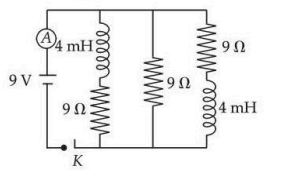
To solve this problem, we need to determine the current through the ammeter at the moment the switch \( K \) is turned ON in the given circuit.
The circuit includes three resistors, each having a resistance of \( 9 \, \Omega \), and two inductors, each having an inductance of \( 4 \, \text{mH} \). When the switch \( K \) is closed, the current through the inductor will initially be zero because of the inductor's property of opposing any change in current.
**Reasoning**:
- At the initial moment when the switch is turned on, the inductors behave as open circuits. This is because an ideal inductor resists changes in current instantaneously due to its inductance, resulting in an initially infinite reactance at \( t = 0 \).
- This means that initially, no current flows through the inductors, and hence, no current flows through the ammeter.
**Conclusion**:
Since the current is initially zero through the inductors, the reading on the ammeter is zero at the moment when the switch \( K \) is turned ON.
Similar Questions
- The electric field of a plane electromagnetic wave, travelling in an unknown non-magnetic medium is given by,
$E_y = 20 \sin(3 \times 10^6 x - 4.5 \times 10^{14} t) \text{ V/m}$
(where x, t and other values have S.I. units). The dielectric constant of the medium is _________.
(speed of light in free space is $3 \times 10^8 \text{ m/s}$) - A capacitor $P$ with capacitance $10 \times 10^{-6} \text{ F}$ is fully charged with a potential difference of 6.0 V and disconnected from the battery. The charged capacitor $P$ is connected across another capacitor $Q$ with capacitance $20 \times 10^{-6} \text{ F}$. The charge on capacitor $Q$ when equilibrium is established will be $\alpha \times 10^{-5} \text{ C}$ (assume capacitor $Q$ does not have any charge initially), the value of $\alpha$ is _________.
- A conducting circular loop is rotated about its diameter at a constant angular speed of 100 rad/s in a magnetic field of 0.5 T perpendicular to the axis of rotation. When the loop is rotated by $30^\circ$ from the horizontal position, the induced EMF is 15.4 mV. The radius of the loop is _________ mm.
$\left(\text{Take } \pi = \frac{22}{7}\right)$ - A cylindrical conductor of length 2 m and area of cross-section $0.2 \text{ mm}^2$ carries an electric current of 1.6 A when its ends are connected to a 2 V battery. Mobility of electrons in the conductor is $\alpha \times 10^{-3} \text{ m}^2\text{/V.s}$. The value of $\alpha$ is :
(electron concentration $= 5 \times 10^{28} \text{/m}^3$ and electron charge = $1.6 \times 10^{-19} \text{ C}$) - There are three co-centric conducting spherical shells $A$, $B$ and $C$ of radii $a$, $b$ and $c$ respectively ($c > b > a$) and they are charged with charge $q_1$, $q_2$ and $q_3$ respectively. The potentials of the spheres $A$, $B$ and $C$ respectively, are :
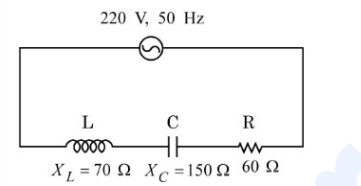
For the series $LCR$ circuit connected with 220 V, 50 Hz a.c source as shown in the figure, the power factor is $\frac{\alpha}{10}$. The value of $\alpha$ is ______.
- Two resistors of $100\, \Omega$ each are connected in series with a 9 V battery. A voltmeter of $400\, \Omega$ resistance is connected to measure the voltage drop across one of the resistors. The voltmeter reading is ______ V.
- The electrostatic potential in a charged spherical region of radius $r$ varies as $V = ar^3 + b$, where $a$ and $b$ are constants. The total charge in the sphere of unit radius is $\alpha \times \pi a \epsilon_0$. The value of $\alpha$ is ______.
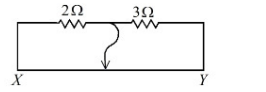
(permittivity of vacuum is $\epsilon_0$) Two resistors $2\, \Omega$ and $3\, \Omega$ are connected in the gaps of bridge as shown in figure. The null point is obtained with the contact of jockey at some point on wire $XY$. When an unknown resistor is connected in parallel with $3\, \Omega$ resistor, the null point is shifted by 22.5 cm toward $Y$. The resistance of unknown resistor is ______ $\Omega$.
Match the LIST-I with LIST-II
List-I: List-II: A. Radio-wave I. is produced by Magnetron valve B. Micro-wave II. due to change in the vibrational modes of atoms C. Infrared-wave III. due to inner shell electrons moving from higher energy level to lower energy level D. X-ray IV. due to rapid acceleration of electrons Choose the correct answer from the options given below:
Important Questions from Electricity and Magnetism
- The electric field of a plane electromagnetic wave, travelling in an unknown non-magnetic medium is given by,
$E_y = 20 \sin(3 \times 10^6 x - 4.5 \times 10^{14} t) \text{ V/m}$
(where x, t and other values have S.I. units). The dielectric constant of the medium is _________.
(speed of light in free space is $3 \times 10^8 \text{ m/s}$) - A capacitor $P$ with capacitance $10 \times 10^{-6} \text{ F}$ is fully charged with a potential difference of 6.0 V and disconnected from the battery. The charged capacitor $P$ is connected across another capacitor $Q$ with capacitance $20 \times 10^{-6} \text{ F}$. The charge on capacitor $Q$ when equilibrium is established will be $\alpha \times 10^{-5} \text{ C}$ (assume capacitor $Q$ does not have any charge initially), the value of $\alpha$ is _________.
- A conducting circular loop is rotated about its diameter at a constant angular speed of 100 rad/s in a magnetic field of 0.5 T perpendicular to the axis of rotation. When the loop is rotated by $30^\circ$ from the horizontal position, the induced EMF is 15.4 mV. The radius of the loop is _________ mm.
$\left(\text{Take } \pi = \frac{22}{7}\right)$ - A cylindrical conductor of length 2 m and area of cross-section $0.2 \text{ mm}^2$ carries an electric current of 1.6 A when its ends are connected to a 2 V battery. Mobility of electrons in the conductor is $\alpha \times 10^{-3} \text{ m}^2\text{/V.s}$. The value of $\alpha$ is :
(electron concentration $= 5 \times 10^{28} \text{/m}^3$ and electron charge = $1.6 \times 10^{-19} \text{ C}$) - There are three co-centric conducting spherical shells $A$, $B$ and $C$ of radii $a$, $b$ and $c$ respectively ($c > b > a$) and they are charged with charge $q_1$, $q_2$ and $q_3$ respectively. The potentials of the spheres $A$, $B$ and $C$ respectively, are :