
The value of the unknown node voltage V1 in the following circuit is :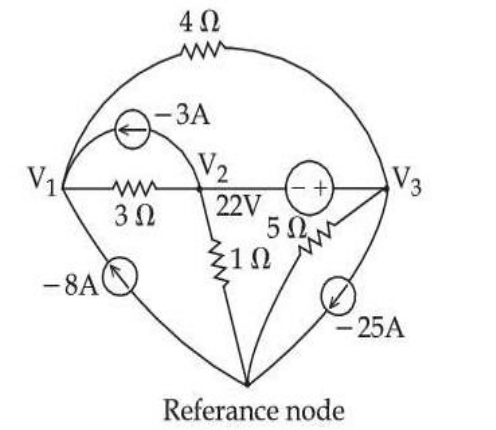
V1 = 1.071 V
The 22 V source sits between two unknown nodes, so V2 and V3 must be treated as a supernode — that is the one decision the problem turns on.
Step 1 — the constraint equation. The source fixes the difference between the two nodes it joins, with its positive terminal at V3:
\(V_{3}-V_{2}=22\quad\Rightarrow\quad V_{3}=V_{2}+22\)
This replaces the KCL equation that could not be written at either node individually, since the current through an ideal voltage source is unknown.
Step 2 — KCL at node V1. Currents leaving through the resistors equal the current injected by the sources, which is \(-3-8=-11\) A:
\(\dfrac{V_{1}-V_{2}}{3}+\dfrac{V_{1}-V_{3}}{4}=-11\)
Multiplying by 12 and substituting \(V_{3}=V_{2}+22\):
\(4(V_{1}-V_{2})+3(V_{1}-V_{2}-22)=-132\)
\(7(V_{1}-V_{2})=-66\quad\Rightarrow\quad V_{1}-V_{2}=-\dfrac{66}{7}=-9.4286\)
Step 3 — KCL around the supernode. Sum the currents leaving the whole V2-V3 island, and equate to the current entering it, \(3+25=28\) A:
\(\dfrac{V_{2}-V_{1}}{3}+\dfrac{V_{2}}{1}+\dfrac{V_{3}-V_{1}}{4}+\dfrac{V_{3}}{5}=28\)
From step 2, \(V_{2}-V_{1}=9.4286\) and \(V_{3}-V_{1}=9.4286+22=31.4286\). Writing \(V_{2}=x\):
\(\dfrac{9.4286}{3}+x+\dfrac{31.4286}{4}+\dfrac{x+22}{5}=28\)
\(3.1429+x+7.8571+0.2x+4.4=28\)
\(1.2x=12.6\quad\Rightarrow\quad x=V_{2}=10.5\ \text{V}\)
Step 4 — back-substitute.
\(V_{1}=V_{2}-9.4286=10.5-9.4286=1.071\ \text{V}\)
— option 2, and \(V_{3}=32.5\) V.
Why the supernode technique is needed. Ordinary nodal analysis writes one KCL equation per node in terms of the resistor currents, but an ideal voltage source has no defined resistance, so its current cannot be expressed in terms of node voltages. Enclosing both of its nodes in one surface makes that unknown current internal — it enters and leaves the same surface and cancels — and the source's own equation supplies the row that was lost. The count still balances: two unknowns, one supernode KCL and one constraint.
On the negative source values: a source labelled –3 A with its arrow towards V1 simply delivers 3 A in the opposite sense, and the algebra handles the signs automatically provided each is entered consistently as current into the node.
Hence, V1 = 1.071 V.
Similar Questions
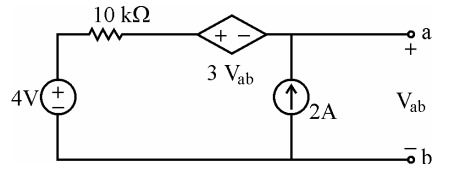
For the circuit shown in figure, the terminal voltage Vab is given by :
Important Questions from Nodal Analysis - Teaching
For the circuit shown in figure, the terminal voltage Vab is given by :



