
For the circuit shown in figure, the terminal voltage Vab is given by :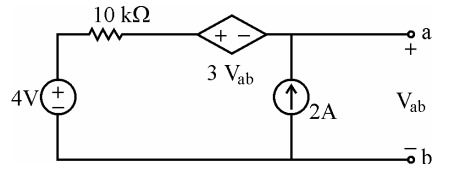
6 V
The controlled source makes this a self-referential problem: Vab appears on both sides of the equation, so set it up and solve.
Step 1 — find the branch current. The output terminals are open, so no current leaves at a. Applying KCL at that node, whatever the 2 A source injects must flow back through the series branch:
\(I=-2\ \text{A}\)
taking I as positive from the supply towards a. The 2 A therefore circulates backwards through the resistor and into the 4 V source.
Step 2 — write KVL round the loop. Starting at b (taken as 0 V), rising through the 4 V source, dropping across the resistor and then across the controlled source:
\(V_{ab}=4-IR-3V_{ab}\)
Substituting \(I=-2\) and R = 10 (the value printed as 10 kΩ, see the note below):
\(V_{ab}=4+2(10)-3V_{ab}\)
\(4V_{ab}=24\qquad\Rightarrow\qquad V_{ab}=6\ \text{V}\)
which is option 2.
| Contribution | Value |
|---|---|
| Source | +4 V |
| Resistor (current flows backwards) | +20 V |
| Controlled source | −3Vab |
| Result | Vab = 6 V |
A note on the units. Taken literally, a 2 A current through 10 kΩ would produce 20 kV, and no option is remotely near that — the answer set only works if the resistance is treated as 10 Ω, or the source as 2 mA. The examiner's arithmetic clearly uses the bare number 10, and 6 V is the value that results; the answer is flagged for confirmation because of that inconsistency in the printed figure.
The point the question is really testing is how to handle a dependent source. Three rules apply:
• A controlled source is never deactivated when applying superposition or when finding a Thevenin resistance — only independent sources are.
• Its value must be expressed in terms of the circuit unknown, which then appears on both sides of the equation and is solved for algebraically, as above.
• Its presence destroys reciprocity, so a network containing one cannot be checked by the reciprocity theorem.
Note also the effect of the feedback. Without the controlled source the terminal voltage would have been 24 V; the source subtracts \(3V_{ab}\) and pulls the result down to a quarter of that. A controlled source that opposes the quantity controlling it behaves exactly like negative feedback, dividing the open-loop result by \(1+3=4\).
Hence, the terminal voltage is 6 V.
Similar Questions
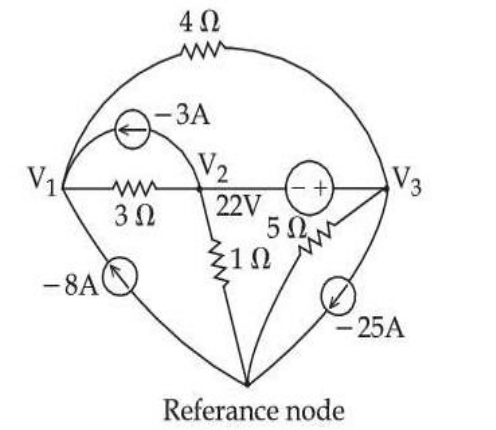
The value of the unknown node voltage V1 in the following circuit is :
Important Questions from Nodal Analysis - Teaching
The value of the unknown node voltage V1 in the following circuit is :



