
The transfer function of the given signal flow graph is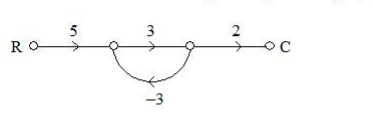
Three
The graph. The signal flows from the input node R through three cascaded branches of gains 5, 3 and 2 to the output node C, with a feedback branch of gain −3 placed around the middle (gain-3) branch.
Tool — Mason's gain formula.
\(T=\dfrac{\sum_k P_k \Delta_k}{\Delta}, \qquad \Delta = 1-\sum L_i+\sum L_iL_j-\ldots\)
where Pk is a forward-path gain, Li are the individual loop gains, and Δk is the determinant with all loops touching path k removed.
Step 1 — forward path. There is exactly one path from R to C that visits no node twice:
\(P_1 = 5\times 3\times 2 = 30\)
Step 2 — loops. One loop exists, formed by the gain-3 forward branch and the −3 feedback branch:
\(L_1 = 3\times(-3) = -9\)
Step 3 — determinant. With a single loop and no non-touching loops:
\(\Delta = 1-L_1 = 1-(-9) = 10\)
Step 4 — path cofactor. The forward path passes through the loop, so no loop remains untouched:
\(\Delta_1 = 1\)
Step 5 — combine.
\(T=\dfrac{P_1\Delta_1}{\Delta}=\dfrac{30\times1}{10}=3\)
Cross-check by block-diagram algebra. The inner loop is a negative-feedback block with forward gain 3 and feedback 3, giving \(3/(1+3\times3)=3/10=0.3\); cascading with the outer gains 5 and 2 gives \(5\times0.3\times2=3\) ✓ — the same answer, which is a good habit for confirming a Mason's-formula result.
Note the distractor. "Thirty" is the raw forward-path gain, i.e. the answer you get if the feedback loop is ignored; the feedback divides it by Δ = 10.
Hence, the transfer function of the signal flow graph is 3 (Three).
Similar Questions
The transfer function of the system shown in the following figure is :
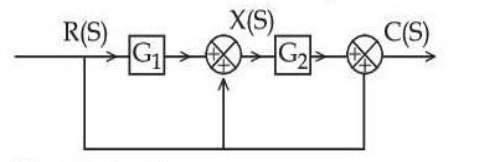
Match the following lists :
List - I List - II a. 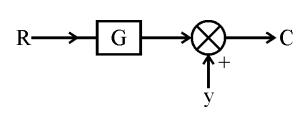
i. 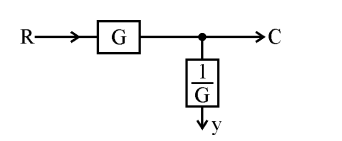
b. 
ii. 
c. 
iii. 
d. 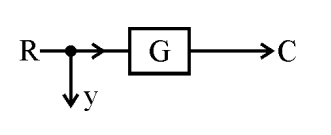
iv. 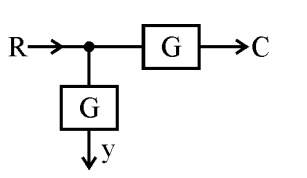
Codes :
Consider the following signal flow graph.
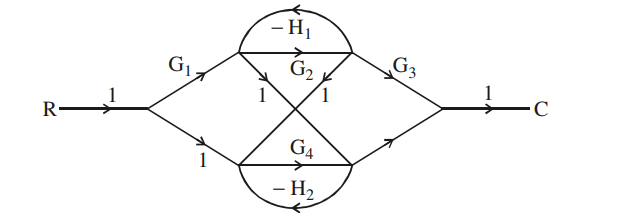
Assume that A is number of forward paths, B is number of feedback loops, C is number of touching loops. Arrange A, B and C in decreasing order :
Important Questions from Block Diagram Reduction Using Signal Flow Graph - Teaching
The transfer function of the system shown in the following figure is :
Match the following lists :
List - I List - II a. i. b. ii. c. iii. d. iv. Codes :
Consider the following signal flow graph.
Assume that A is number of forward paths, B is number of feedback loops, C is number of touching loops. Arrange A, B and C in decreasing order :



