
1. presence of at least one $\beta$-hydrogen
2. presence of at least one $\alpha$-hydrogen
3. Concentrated base
4. lack of $\alpha$ hydrogen
Alpha Hydrogen Requirement for Aldol Condensation
Aldol condensation is a fundamental reaction in organic chemistry typically involving two molecules of an aldehyde or ketone (or one molecule in intramolecular reactions) reacting in the presence of a base or acid catalyst. The reaction results in the formation of a carbon-carbon bond.
Understanding the Mechanism
The key step in the Aldol condensation mechanism involves the formation of an enolate ion. This happens when a base abstracts a proton from the $\alpha$-carbon of a carbonyl compound.
- The $\alpha$-carbon is defined as the carbon atom directly attached to the carbonyl group (C=O).
- The hydrogen atoms attached to this $\alpha$-carbon are called $\alpha$-hydrogens.
These $\alpha$-hydrogens are acidic because the resulting conjugate base (the enolate ion) is stabilized by resonance. The negative charge is delocalized between the $\alpha$-carbon and the electronegative oxygen atom of the carbonyl group.
For example, in acetaldehyde (CH3CHO), the methyl group carbons are the $\alpha$-carbons, and the hydrogens attached to them are $\alpha$-hydrogens.
Reaction Step (Simplified):
Base + CH3-CHO $\rightleftharpoons$ Enolate Ion + Conjugate Acid
The enolate ion, being a strong nucleophile, then attacks the electrophilic carbonyl carbon of another aldehyde or ketone molecule, initiating the condensation process.
Why Alpha Hydrogen is Essential
Therefore, the structural feature that is absolutely necessary for a carbonyl compound to undergo Aldol condensation is the presence of at least one $\alpha$-hydrogen. This allows for the initial deprotonation step and the formation of the reactive enolate intermediate.
Evaluating Other Options
- Presence of at least one $\beta$-hydrogen: While $\beta$-hydrogens are important for the subsequent dehydration step (aldol *addition* followed by elimination) that often follows the initial aldol *condensation*, they are not required for the condensation step itself. The $\beta$-carbon is two carbons away from the carbonyl group.
- Concentrated base: A base (often dilute) is required as a catalyst to abstract the $\alpha$-hydrogen. While the concentration can influence reaction rate or side reactions, it's a condition for the reaction, not an intrinsic structural feature of the carbonyl compound itself.
- Lack of $\alpha$ hydrogen: Carbonyl compounds lacking $\alpha$-hydrogens, such as formaldehyde or certain ketones like 3,3-dimethyl-2-butanone, cannot form enolates via deprotonation at the $\alpha$-carbon and therefore cannot undergo the standard Aldol condensation.
Conclusion
The critical structural requirement for a carbonyl compound to participate in Aldol condensation is the ability to form an enolate ion, which necessitates the presence of at least one $\alpha$-hydrogen.
Important Questions from Aldehydes, Ketones and Carboxylic Acids
Phenol is brominated in solvent CS₂ at low temperature. The product formed are:
What is not true regarding compound [B]?
(A) They are higher boiling liquids than aldehydes and ketones due to extensive H bonding
(B) They are soluble in Benzene
(C) They produce alkane when heated with soda lime
(D) Produces CO₂ when treated with NaHCO₃
Choose the correct answer from the options given below:
Which of the following is the correct statement for hybridization of C-atom and number of π bonds in the Carbonyl group?
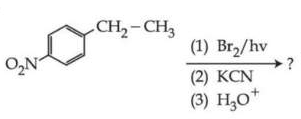
What is the product formed in the following reaction sequence?
What will be the product formed when cyclohexanone undergoes Aldol condensation?


