
The stability of the system for different locations of poles and zeroes : Codes :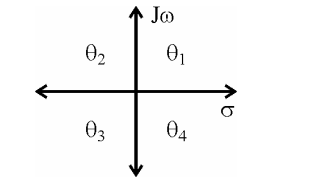
List – I List – II a. Stable i. $\theta_4$ b. Unstable ii. $\theta_2$ c. Stable in limited sense or marginally stable iii. $\theta_1$ d. Asymptotic iv. $\theta_3$
a-ii, b-iii, c-i, d-iv
The sign of \(\sigma\) decides stability, so the left-hand quadrants θ2 and θ3 must carry the stable entries and the right-hand quadrants θ1 and θ4 the unstable ones. That single test disposes of most of the options.
| Quadrant | Position | Real part | Behaviour |
|---|---|---|---|
| θ1 | Upper right | Positive | Growing oscillation |
| θ2 | Upper left | Negative | Decaying oscillation |
| θ3 | Lower left | Negative | Decaying oscillation |
| θ4 | Lower right | Positive | Growing oscillation |
Applying it to the codes. Entries a (stable) and d (asymptotic) both describe decaying responses and belong on the left; b (unstable) belongs on the right. Options 3 and 4 both begin with a-θ1, placing a stable system in the right half plane, and fall at once. Option 1 gives d-θ1, putting an asymptotically stable system in the right half plane — equally impossible. Option 2 is the only code that keeps both stable entries on the left and both remaining entries on the right: a-θ2, b-θ1, c-θ4, d-θ3.
The distinction between a and d is a real one, not a repetition. Stable in the bounded-input bounded-output sense means a bounded input never produces an unbounded output. Asymptotically stable is stronger: the response must in addition return to equilibrium as \(t\to\infty\). For a linear time-invariant system with no pole-zero cancellation the two coincide, both requiring every pole strictly in the left half plane — which is why the code assigns them the two left-hand quadrants, θ2 and θ3, the pair that a complex conjugate root always occupies together.
Why the answer is flagged. Entry c, marginal stability, strictly requires poles on the jω axis — the boundary between the quadrants, not any quadrant itself. No offered code can place it correctly, so it falls to θ4 by elimination once the three sound assignments are made. The question's own framing is at fault here.
Note also that zeroes play no part, despite the wording. Zeroes shape the transient — overshoot, undershoot, the size of each modal term — but stability is decided by the poles alone.
Hence, the code is a-θ2, b-θ1, c-θ4, d-θ3.
Similar Questions
If any root of the characteristic equation of a system has a positive real part, impulse response g(t) is unbounded and \(\int_{0}^{\infty}\left|g(\tau)\right|d\tau\) is infinite, then the system is :
Read the following statements :
(a) Stability is a performance measure of a system.
(b) A system is stable if all the poles of the transfer function have positive real part.
(c) A system is stable if all the zeros of the transfer function have negative real parts.
(d) A system is stable if all the poles of the transfer function have negative real parts.
Which of the above statement/s is/are correct ?
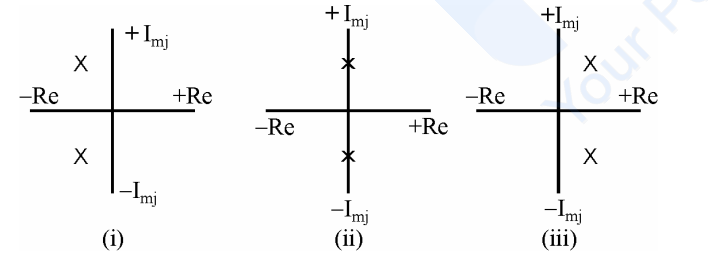
From the location of the roots of S-plane, determine the stability of the system :
Important Questions from Condition For Stability - Teaching
If any root of the characteristic equation of a system has a positive real part, impulse response g(t) is unbounded and \(\int_{0}^{\infty}\left|g(\tau)\right|d\tau\) is infinite, then the system is :
Read the following statements :
(a) Stability is a performance measure of a system.
(b) A system is stable if all the poles of the transfer function have positive real part.
(c) A system is stable if all the zeros of the transfer function have negative real parts.
(d) A system is stable if all the poles of the transfer function have negative real parts.
Which of the above statement/s is/are correct ?
From the location of the roots of S-plane, determine the stability of the system :



