
From the location of the roots of S-plane, determine the stability of the system :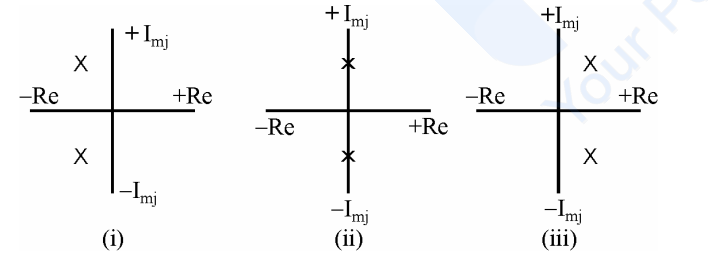
(i) stable, (ii) sustained oscillation, (iii) unstable
The real part of a pole decides everything, because a pole at \(s=-\sigma\pm j\omega\) contributes a term
\(e^{-\sigma t}\left(A\cos\omega t+B\sin\omega t\right)\)
to the response. The exponential envelope is what grows, decays or stays constant, and its sign is the real part.
| Root location | Real part | Envelope | Verdict |
|---|---|---|---|
| (i) Left half plane | Negative | \(e^{-\sigma t}\) decays | Stable |
| (ii) On the jω axis | Zero | Constant amplitude | Sustained oscillation (marginally stable) |
| (iii) Right half plane | Positive | \(e^{+\sigma t}\) grows | Unstable |
So (i) stable, (ii) sustained oscillation, (iii) unstable — option 2.
The imaginary part plays no part in the verdict. It sets the frequency of the ringing, not whether the response settles: a pair of complex poles far from the real axis oscillates rapidly, a pair close to it slowly, but both decay if their real part is negative. Two roots on the real axis with no imaginary part decay without oscillating at all.
Why the jω-axis case is the delicate one. A pole exactly on the axis gives an output that neither dies away nor grows — it oscillates for ever at \(\omega\). That is bounded for a bounded input in most cases, hence "marginally stable", but it is useless as a control system and impossible to hold in practice, since any drift pushes the pole one way or the other. It is, however, exactly what an oscillator is designed to achieve, which is the same condition seen from the other side. A repeated pair on the axis is worse still: the response then grows as \(t\sin\omega t\) and the system is genuinely unstable.
The connection to the Routh array completes the picture: no sign change in the first column corresponds to case (i); a complete row of zeros signals case (ii), and the auxiliary equation formed from the row above gives the frequency of that sustained oscillation; sign changes count the right-half-plane roots of case (iii).
Hence, the correct reading is (i) stable, (ii) sustained oscillation, (iii) unstable.
Similar Questions
The stability of the system for different locations of poles and zeroes :
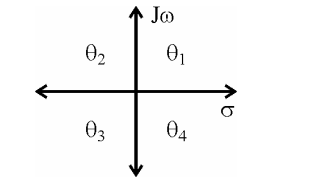
List – I List – II a. Stable i. $\theta_4$ b. Unstable ii. $\theta_2$ c. Stable in limited sense or marginally stable iii. $\theta_1$ d. Asymptotic iv. $\theta_3$ Codes :
If any root of the characteristic equation of a system has a positive real part, impulse response g(t) is unbounded and \(\int_{0}^{\infty}\left|g(\tau)\right|d\tau\) is infinite, then the system is :
Read the following statements :
(a) Stability is a performance measure of a system.
(b) A system is stable if all the poles of the transfer function have positive real part.
(c) A system is stable if all the zeros of the transfer function have negative real parts.
(d) A system is stable if all the poles of the transfer function have negative real parts.
Which of the above statement/s is/are correct ?
Important Questions from Condition For Stability - Teaching
The stability of the system for different locations of poles and zeroes :
List – I List – II a. Stable i. $\theta_4$ b. Unstable ii. $\theta_2$ c. Stable in limited sense or marginally stable iii. $\theta_1$ d. Asymptotic iv. $\theta_3$ Codes :
If any root of the characteristic equation of a system has a positive real part, impulse response g(t) is unbounded and \(\int_{0}^{\infty}\left|g(\tau)\right|d\tau\) is infinite, then the system is :
Read the following statements :
(a) Stability is a performance measure of a system.
(b) A system is stable if all the poles of the transfer function have positive real part.
(c) A system is stable if all the zeros of the transfer function have negative real parts.
(d) A system is stable if all the poles of the transfer function have negative real parts.
Which of the above statement/s is/are correct ?



