
If any root of the characteristic equation of a system has a positive real part, impulse response g(t) is unbounded and \(\int_{0}^{\infty}\left|g(\tau)\right|d\tau\) is infinite, then the system is :
Unstable
Each of the three conditions the question lists is on its own sufficient to declare the system unstable — option 4 — and it is worth seeing that they are three descriptions of one fact.
| Statement | What it says |
|---|---|
| A root has positive real part | A pole lies in the right half plane |
| g(t) is unbounded | The impulse response grows without limit |
| \(\int_{0}^{\infty}|g(\tau)|d\tau\) is infinite | The response is not absolutely integrable |
How the three connect. A pole at \(s=\sigma+j\omega\) contributes a term
\(e^{\sigma t}\left(A\cos\omega t+B\sin\omega t\right)\)
to the impulse response. If \(\sigma\gt0\) the exponential envelope grows, so g(t) is unbounded — the second statement. And a growing function certainly cannot have a finite integral of its magnitude — the third. Each follows from the first.
Why absolute integrability is the formal criterion. A system is BIBO stable if and only if
\(\int_{0}^{\infty}\left|g(\tau)\right|d\tau\lt\infty\)
The reason is that the output is the convolution of input and impulse response, so a bounded input of magnitude M gives
\(\left|y(t)\right|\le M\int_{0}^{\infty}\left|g(\tau)\right|d\tau\)
A finite integral therefore guarantees a bounded output; an infinite one means some bounded input will drive the output to infinity.
Distinguishing the other three terms, since the question offers them.
Absolutely stable means every pole lies strictly in the left half plane, so the response decays for all values of gain in the range considered.
Marginally stable means a simple pole pair sits exactly on the imaginary axis: the response neither grows nor decays but oscillates for ever at that frequency. Note that repeated poles on the axis give a response growing as \(t\sin\omega t\), which is genuinely unstable.
Critically stable is used for the same boundary condition, the point at which a gain increase would push the poles across into the right half plane.
None of these describes a pole with a positive real part, which lies unambiguously outside the stable region. In a physical system the growth is eventually stopped by saturation or by mechanical failure, but the linear model correctly predicts an unbounded response.
Hence, the system is unstable.
Similar Questions
The stability of the system for different locations of poles and zeroes :
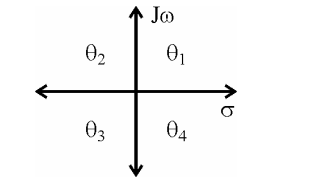
List – I List – II a. Stable i. $\theta_4$ b. Unstable ii. $\theta_2$ c. Stable in limited sense or marginally stable iii. $\theta_1$ d. Asymptotic iv. $\theta_3$ Codes :
Read the following statements :
(a) Stability is a performance measure of a system.
(b) A system is stable if all the poles of the transfer function have positive real part.
(c) A system is stable if all the zeros of the transfer function have negative real parts.
(d) A system is stable if all the poles of the transfer function have negative real parts.
Which of the above statement/s is/are correct ?
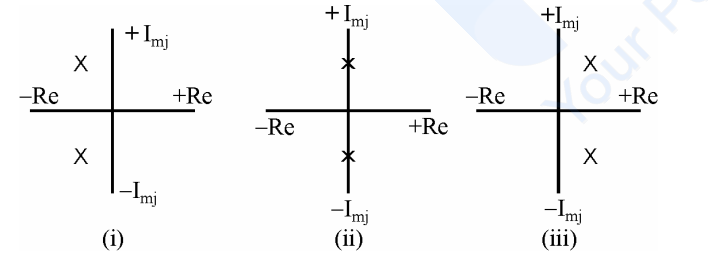
From the location of the roots of S-plane, determine the stability of the system :
Important Questions from Condition For Stability - Teaching
The stability of the system for different locations of poles and zeroes :
List – I List – II a. Stable i. $\theta_4$ b. Unstable ii. $\theta_2$ c. Stable in limited sense or marginally stable iii. $\theta_1$ d. Asymptotic iv. $\theta_3$ Codes :
Read the following statements :
(a) Stability is a performance measure of a system.
(b) A system is stable if all the poles of the transfer function have positive real part.
(c) A system is stable if all the zeros of the transfer function have negative real parts.
(d) A system is stable if all the poles of the transfer function have negative real parts.
Which of the above statement/s is/are correct ?
From the location of the roots of S-plane, determine the stability of the system :



