
The secondary pollutant in the troposphere is
O3
Understanding Air Pollutants in the Troposphere
Air pollutants can be classified based on how they are formed in the atmosphere. They are primarily categorized as either primary or secondary pollutants.
- Primary Pollutants: These are pollutants emitted directly into the atmosphere from identifiable sources like factories, vehicles, or natural events (e.g., volcanic eruptions). Examples include sulfur dioxide (\(SO_2\)), nitrogen oxides (\(NO_x\)), carbon monoxide (\(CO\)), and particulate matter.
- Secondary Pollutants: These are pollutants that are not directly emitted but are formed in the atmosphere through chemical reactions between primary pollutants and other atmospheric components, often catalyzed by sunlight.
Analyzing Common Tropospheric Pollutants
Let's examine the given options in the context of this classification:
- \(CO_2\) (Carbon Dioxide): While a major greenhouse gas and a pollutant in excess, \(CO_2\) is emitted directly from combustion processes (burning fossil fuels, biomass). It is considered a primary pollutant.
- \(SO_2\) (Sulfur Dioxide): This gas is primarily produced from burning fossil fuels (especially coal) that contain sulfur impurities. It is released directly into the atmosphere, making it a primary pollutant.
- \(NO_x\) (Nitrogen Oxides): This term generally refers to nitric oxide (\(NO\)) and nitrogen dioxide (\(NO_2\)). They are formed during high-temperature combustion processes, such as in vehicle engines and power plants. \(NO\) and \(NO_2\) are emitted directly and are thus considered primary pollutants.
- \(O_3\) (Ozone): Ozone in the troposphere (ground-level ozone) is not emitted directly. It is formed through a complex series of photochemical reactions involving primary pollutants like nitrogen oxides (\(NO_x\)) and volatile organic compounds (VOCs) in the presence of sunlight. Because it is formed from the reaction of other pollutants, tropospheric ozone is a classic example of a secondary pollutant.
Why Ozone (\(O_3\)) is a Secondary Pollutant
The formation of tropospheric ozone involves several steps. Nitrogen dioxide (\(NO_2\)), a primary pollutant, absorbs sunlight and breaks down into nitric oxide (\(NO\)) and a free oxygen atom (\(O\)):
\(NO_2 + \text{Sunlight} \rightarrow NO + O\)
The free oxygen atom (\(O\)) is highly reactive and quickly combines with an oxygen molecule (\(O_2\)) in the air to form ozone (\(O_3\)):
\(O + O_2 \rightarrow O_3\)
In the absence of VOCs, \(NO\) would react with \(O_3\) to reform \(NO_2\) and \(O_2\), balancing the reaction. However, the presence of VOCs disrupts this balance, leading to a net accumulation of \(O_3\). Since ozone is formed from the reaction of other pollutants (\(NO_x\)) triggered by sunlight, it is classified as a secondary pollutant.
Summary of Pollutant Types
| Pollutant | Chemical Formula | Classification (Troposphere) | Reason |
|---|---|---|---|
| Carbon Dioxide | \(CO_2\) | Primary | Directly emitted from combustion |
| Sulfur Dioxide | \(SO_2\) | Primary | Directly emitted from burning sulfur-containing fuels |
| Nitrogen Oxides | \(NO_x\) (\(NO\), \(NO_2\)) | Primary | Directly emitted from high-temperature combustion |
| Ozone (Tropospheric) | \(O_3\) | Secondary | Formed by reactions involving \(NO_x\), VOCs, and sunlight |
Based on this analysis, ozone (\(O_3\)) is the secondary pollutant among the given options.
Revision Table: Air Pollution Basics
| Term | Definition/Key Point |
|---|---|
| Troposphere | Lowest layer of Earth's atmosphere, where weather occurs and most air pollution accumulates. |
| Primary Pollutant | Emitted directly from a source. |
| Secondary Pollutant | Formed in the atmosphere via chemical reactions of primary pollutants. |
| Photochemical Smog | A type of air pollution formed by the reaction of sunlight with \(NO_x\) and VOCs; ozone is a key component. |
Additional Information: Tropospheric vs. Stratospheric Ozone
It's important to distinguish between ozone in the troposphere and ozone in the stratosphere:
- Tropospheric Ozone (\(O_3\)): This is ground-level ozone, a major component of smog. It is a harmful air pollutant that irritates the respiratory system, damages plants, and contributes to climate change. It is a secondary pollutant.
- Stratospheric Ozone (\(O_3\)): Found in the stratosphere (about 10-50 km above the surface), this ozone layer is beneficial. It absorbs most of the Sun's harmful ultraviolet (UV) radiation, protecting life on Earth. While naturally formed, certain chemicals (like CFCs) deplete this protective layer.
Therefore, ozone's effect depends on its location in the atmosphere – harmful in the troposphere (where it's a secondary pollutant) and beneficial in the stratosphere.
Important Questions from Meteorology
- Inversion that occurs near Earth’s Surface is called :
- A moist air parcel at $24^\circ\text{C}$ has a mixing ratio of $10 \text{ g per kg}$. Its virtual temperature is :
- In an urban area, moist air at 27 °C has a mixing ratio of 50 gm per kg. Its virtual temperature is
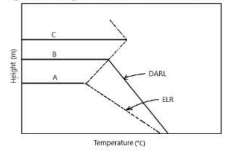
The atmospheric condition at a given time is shown in figure given below. If the average wind speed that prevailed was 10 m/s, what will be the ventilation coefficient?
- Match the LIST-I with LIST-II
LIST-I
Reduction in Ambient temperature with height is Y. Dry and saturated adiabatic lapse rates are Yd and Ys, respectivelyLIST-II
Stability classA. Y < Ys I. Absolutely Unstable B. Y > Yd II. Conditionally Unstable C. Y = Yd III. Absolutely Stable D. Ys > Y > Yd IV. Dry Neutral
Choose the correct answer from the options given below:


