
Understanding Inversion Near Earth's Surface
An atmospheric inversion is a condition where a layer of warmer air exists above a layer of cooler air, which is the opposite of the normal atmospheric profile (temperature decreasing with altitude).
Types of Atmospheric Inversions
Several types of inversions exist, distinguished by their formation mechanisms:
- Radiation Inversion: Forms primarily on clear, calm nights. The ground loses heat rapidly through radiation, cooling the air layer directly above it. The air aloft remains relatively warmer, creating an inversion. This is a common type occurring near the Earth's surface.
- Advectional Inversion: Occurs when warm air moves horizontally (advects) over a colder surface (like snow or cold water). The lower layer of air is cooled by the surface.
- Subsidence Inversion: Develops when a large air mass sinks (subsides) and compresses. As the air sinks, it warms adiabatically. This warmer, sinking air aloft sits above cooler surface air.
- Cold-air-drainage Inversion: Occurs when cold, dense air flows downslope under gravity, accumulating in valleys and low-lying areas, trapping warmer air above it.
Identifying Surface Inversion
The question specifically asks for an inversion occurring near Earth's surface. Radiation inversions are directly caused by the cooling of the Earth's surface and thus characteristically form at or very close to the ground level.
Therefore, the inversion that occurs near Earth's surface due to radiative cooling of the ground is called a Radiation inversion.
Important Questions from Meteorology
The secondary pollutant in the troposphere is
- A moist air parcel at $24^\circ\text{C}$ has a mixing ratio of $10 \text{ g per kg}$. Its virtual temperature is :
- In an urban area, moist air at 27 °C has a mixing ratio of 50 gm per kg. Its virtual temperature is
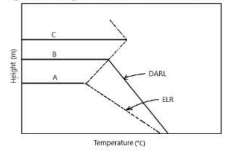
The atmospheric condition at a given time is shown in figure given below. If the average wind speed that prevailed was 10 m/s, what will be the ventilation coefficient?
- Match the LIST-I with LIST-II
LIST-I
Reduction in Ambient temperature with height is Y. Dry and saturated adiabatic lapse rates are Yd and Ys, respectivelyLIST-II
Stability classA. Y < Ys I. Absolutely Unstable B. Y > Yd II. Conditionally Unstable C. Y = Yd III. Absolutely Stable D. Ys > Y > Yd IV. Dry Neutral
Choose the correct answer from the options given below:


