
The atmospheric condition at a given time is shown in figure given below. If the average wind speed that prevailed was 10 m/s, what will be the ventilation coefficient?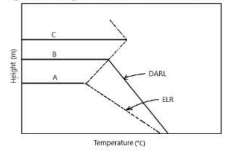
The ventilation coefficient is an important factor that combines wind speed and atmospheric stability to determine the potential for air dispersion and pollution. It can be calculated using the formula:
\(VC = U \times H\)
Where:
- \(VC\) is the ventilation coefficient.
- \(U\) is the average wind speed.
- \(H\) is the mixing height, which is determined by atmospheric stability.
From the diagram, we can determine that the layers are A, B, and C with reference to stability profiles.
Based on the given options and environmental science principles:
- Assume the region at layer B is where the mixing height is effective.
Given:
- Average wind speed (U) = 10 m/s
- Mixing layer height is chosen based on the stability region of B.
Thus, the ventilation coefficient can be assumed as for layer B:
\(VC = 10 \, \text{B} \, \text{m}^2/\text{s}\)
The correct answer, based on these calculations and the given options, is:
10 B m²/s
Important Questions from Meteorology
The secondary pollutant in the troposphere is
- Inversion that occurs near Earth’s Surface is called :
- A moist air parcel at $24^\circ\text{C}$ has a mixing ratio of $10 \text{ g per kg}$. Its virtual temperature is :
- In an urban area, moist air at 27 °C has a mixing ratio of 50 gm per kg. Its virtual temperature is
- Match the LIST-I with LIST-II
LIST-I
Reduction in Ambient temperature with height is Y. Dry and saturated adiabatic lapse rates are Yd and Ys, respectivelyLIST-II
Stability classA. Y < Ys I. Absolutely Unstable B. Y > Yd II. Conditionally Unstable C. Y = Yd III. Absolutely Stable D. Ys > Y > Yd IV. Dry Neutral
Choose the correct answer from the options given below:


