
Calculating Virtual Temperature for Moist Air
The virtual temperature ($T_v$) represents the temperature at which dry air of the same pressure and density would exist. It is calculated using the actual air temperature ($T$) and the mixing ratio ($r$).
Step 1: Convert Temperature to Kelvin
The given ambient air temperature is $T = 27 \text{ °C}$. Convert this to Kelvin (K):
$ T (\text{K}) = T (\text{°C}) + 273.15 $
$ T = 27 + 273.15 = 300.15 \text{ K} $
Step 2: Convert Mixing Ratio to kg/kg
The given mixing ratio is $r = 50 \text{ gm/kg}$. Convert this to kilograms per kilogram (kg/kg):
$ r (\text{kg/kg}) = \frac{r (\text{gm/kg})}{1000} $
$ r = \frac{50}{1000} = 0.050 \text{ kg/kg} $
Step 3: Calculate Virtual Temperature
Use the approximate formula for virtual temperature:
$ T_v \approx T \times (1 + 0.61 \times r) $
Substitute the values in Kelvin and kg/kg:
$ T_v \approx 300.15 \text{ K} \times (1 + 0.61 \times 0.050) $
$ T_v \approx 300.15 \text{ K} \times (1 + 0.0305) $
$ T_v \approx 300.15 \text{ K} \times 1.0305 $
$ T_v \approx 309.30 \text{ K} $
Step 4: Convert Virtual Temperature back to Celsius
Convert the calculated virtual temperature from Kelvin back to Celsius (°C):
$ T_v (\text{°C}) = T_v (\text{K}) - 273.15 $
$ T_v (\text{°C}) \approx 309.30 - 273.15 $
$ T_v (\text{°C}) \approx 36.15 \text{ °C} $
The virtual temperature of the moist air is approximately 36.15 °C.
Important Questions from Meteorology
The secondary pollutant in the troposphere is
- Inversion that occurs near Earth’s Surface is called :
- A moist air parcel at $24^\circ\text{C}$ has a mixing ratio of $10 \text{ g per kg}$. Its virtual temperature is :
The atmospheric condition at a given time is shown in figure given below. If the average wind speed that prevailed was 10 m/s, what will be the ventilation coefficient?
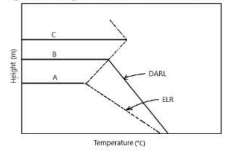
- Match the LIST-I with LIST-II
LIST-I
Reduction in Ambient temperature with height is Y. Dry and saturated adiabatic lapse rates are Yd and Ys, respectivelyLIST-II
Stability classA. Y < Ys I. Absolutely Unstable B. Y > Yd II. Conditionally Unstable C. Y = Yd III. Absolutely Stable D. Ys > Y > Yd IV. Dry Neutral
Choose the correct answer from the options given below:


