LIST-I
Reduction in Ambient temperature with height is Y. Dry and saturated adiabatic lapse rates are Yd and Ys, respectivelyLIST-II
Stability classA. Y < Ys I. Absolutely Unstable B. Y > Yd II. Conditionally Unstable C. Y = Yd III. Absolutely Stable D. Ys > Y > Yd IV. Dry Neutral
Choose the correct answer from the options given below:
Lapse Rate Comparison Basics
Atmospheric stability is a key concept in meteorology, describing how an air parcel behaves when displaced vertically. It is determined by comparing the environmental lapse rate (Y), which is the actual rate of temperature decrease with height in the atmosphere, to specific adiabatic lapse rates.
- Dry Adiabatic Lapse Rate (Yd): This is the rate at which an unsaturated parcel of air cools as it rises and expands due to lower pressure. It is approximately $10$ °C per $1000$ m (or $0.0098$ °C/m).
- Saturated Adiabatic Lapse Rate (Ys): This is the rate at which a saturated parcel of air cools as it rises. Condensation releases latent heat, slowing down the cooling process compared to the dry adiabatic rate. It varies with temperature and pressure but is typically around $5$ °C per $1000$ m (or $0.005$ °C/m).
Stability Class Criteria
The relationship between Y, Yd, and Ys defines different atmospheric stability conditions:
- Absolutely Stable: Occurs when the environmental lapse rate is less than the saturated adiabatic lapse rate ($Y < Ys$). A displaced parcel will always be cooler and denser than its surroundings, tending to return to its original position.
- Absolutely Unstable: Occurs when the environmental lapse rate is greater than the dry adiabatic lapse rate ($Y > Yd$). A displaced parcel will always be warmer and less dense than its surroundings, accelerating further away from its original position.
- Dry Neutral: Occurs when the environmental lapse rate is equal to the dry adiabatic lapse rate ($Y = Yd$). A displaced parcel will have the same temperature and density as its surroundings, remaining in its new position.
- Conditionally Unstable: Occurs when the environmental lapse rate is between the saturated and dry adiabatic lapse rates ($Ys > Y > Yd$). The atmosphere is stable if the air parcel is unsaturated but becomes unstable if it becomes saturated.
Conditions Determining Stability
This question asks to match the conditions described in List-I with the corresponding stability classes in List-II:
A. Y < Ys: This condition means the environmental lapse rate (Y) is less than the saturated adiabatic lapse rate (Ys). This is the criterion for Absolutely Stable conditions. Thus, A matches with III. Absolutely Stable.
B. Y > Yd: This condition means the environmental lapse rate (Y) is greater than the dry adiabatic lapse rate (Yd). This is the criterion for Absolutely Unstable conditions. Thus, B matches with I. Absolutely Unstable.
C. Y = Yd: This condition means the environmental lapse rate (Y) is equal to the dry adiabatic lapse rate (Yd). This defines Dry Neutral conditions. Thus, C matches with IV. Dry Neutral.
D. Ys > Y > Yd: This condition means the environmental lapse rate (Y) falls between the saturated adiabatic lapse rate (Ys) and the dry adiabatic lapse rate (Yd). This is the definition of Conditionally Unstable conditions. Thus, D matches with II. Conditionally Unstable.
| List-I Condition | List-II Stability Class | Description |
|---|---|---|
| A. $Y < Ys$ | III. Absolutely Stable | Environmental lapse rate is less than the saturated adiabatic rate. |
| B. $Y > Yd$ | I. Absolutely Unstable | Environmental lapse rate is greater than the dry adiabatic rate. |
| C. $Y = Yd$ | IV. Dry Neutral | Environmental lapse rate is equal to the dry adiabatic rate. |
| D. $Ys > Y > Yd$ | II. Conditionally Unstable | Environmental lapse rate is between the saturated and dry adiabatic rates. |
Lapse Rate Stability Matches
Based on the analysis of each condition:
- A (Y < Ys) matches with III (Absolutely Stable).
- B (Y > Yd) matches with I (Absolutely Unstable).
- C (Y = Yd) matches with IV (Dry Neutral).
- D (Ys > Y > Yd) matches with II (Conditionally Unstable).
Therefore, the correct sequence of matches is A-III, B-I, C-IV, D-II.
Important Questions from Meteorology
The secondary pollutant in the troposphere is
- Inversion that occurs near Earth’s Surface is called :
- A moist air parcel at $24^\circ\text{C}$ has a mixing ratio of $10 \text{ g per kg}$. Its virtual temperature is :
- In an urban area, moist air at 27 °C has a mixing ratio of 50 gm per kg. Its virtual temperature is
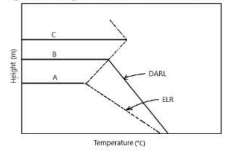
The atmospheric condition at a given time is shown in figure given below. If the average wind speed that prevailed was 10 m/s, what will be the ventilation coefficient?