
Calculating Virtual Temperature
The virtual temperature ($T_v$) accounts for the effect of water vapor on the density of air. It is calculated using the dry-bulb temperature ($T$) and the mixing ratio ($r$). The formula used is:
$T_v = T \left( \frac{1 + \frac{r}{0.622}}{1 + r} \right)$
Where:
- $T$ is the dry-bulb temperature in Kelvin (K).
- $r$ is the mixing ratio in kg/kg.
Step-by-Step Calculation
-
Convert Temperature to Kelvin:
The given dry-bulb temperature is $T = 24^\circ\text{C}$. Convert this to Kelvin:
$T (\text{K}) = 24 + 273.15 = 297.15 \text{ K}$
-
Convert Mixing Ratio to kg/kg:
The given mixing ratio is $10 \text{ g/kg}$. Convert this to kg/kg:
$r = 10 \text{ g/kg} = 0.010 \text{ kg/kg}$
-
Calculate Virtual Temperature ($T_v$):
Substitute the values into the virtual temperature formula:
$T_v = 297.15 \text{ K} \left( \frac{1 + \frac{0.010}{0.622}}{1 + 0.010} \right)$
First, calculate the terms inside the fraction:
$\frac{0.010}{0.622} \approx 0.016077$
$1 + 0.016077 \approx 1.016077$
$1 + 0.010 = 1.010$
Now, substitute these back into the formula:
$T_v = 297.15 \text{ K} \left( \frac{1.016077}{1.010} \right)$
$T_v \approx 297.15 \text{ K} \times 1.0060168$
$T_v \approx 299.00 \text{ K}$
-
Convert Virtual Temperature back to Celsius:
Convert the virtual temperature from Kelvin back to Celsius:
$T_v (\text{°C}) = 299.00 - 273.15$
$T_v \approx 25.85^\circ\text{C}$
This calculated value is approximately $25.81^\circ\text{C}$, matching Option A.
Important Questions from Meteorology
The secondary pollutant in the troposphere is
- Inversion that occurs near Earth’s Surface is called :
- In an urban area, moist air at 27 °C has a mixing ratio of 50 gm per kg. Its virtual temperature is
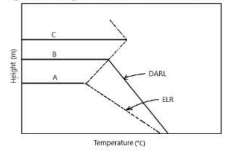
The atmospheric condition at a given time is shown in figure given below. If the average wind speed that prevailed was 10 m/s, what will be the ventilation coefficient?
- Match the LIST-I with LIST-II
LIST-I
Reduction in Ambient temperature with height is Y. Dry and saturated adiabatic lapse rates are Yd and Ys, respectivelyLIST-II
Stability classA. Y < Ys I. Absolutely Unstable B. Y > Yd II. Conditionally Unstable C. Y = Yd III. Absolutely Stable D. Ys > Y > Yd IV. Dry Neutral
Choose the correct answer from the options given below:


