Shuttle Loom Sley Acceleration Ratio Calculation
This solution calculates the ratio of sley acceleration at the front and back centres for a shuttle loom, based on the given crank radius and connecting rod length.
Mechanism Parameters
Identify the key parameters provided:
- Crank Radius: $r = 10 \text{ cm}$
- Connecting Rod Length: $l = 40 \text{ cm}$
Sley Acceleration Formula
The acceleration ($a$) of the sley (reciprocating part) in a crank-driven mechanism can be approximated using the formula:
$a \approx \omega^2 r \left( \cos \theta + \frac{r}{l} \cos(2\theta) \right)$
Where $\omega$ is the constant angular velocity of the crank and $\theta$ is the crank angle.
Acceleration at Front Centre
The front centre position is typically when the crank angle $\theta = 0^\circ$.
- At $\theta = 0^\circ$, $\cos \theta = \cos(0^\circ) = 1$ and $\cos(2\theta) = \cos(0^\circ) = 1$.
- Substituting into the formula, the acceleration at the front centre ($a_{front}$) is: $a_{front} \approx \omega^2 r \left( 1 + \frac{r}{l} \times 1 \right) = \omega^2 r \left( 1 + \frac{r}{l} \right)$
Acceleration at Back Centre
The back centre position is typically when the crank angle $\theta = 180^\circ$.
- At $\theta = 180^\circ$, $\cos \theta = \cos(180^\circ) = -1$ and $\cos(2\theta) = \cos(360^\circ) = 1$.
- Substituting into the formula, the acceleration at the back centre ($a_{back}$) is: $a_{back} \approx \omega^2 r \left( -1 + \frac{r}{l} \times 1 \right) = \omega^2 r \left( -1 + \frac{r}{l} \right)$
Ratio Calculation
Calculate the ratio of the sley acceleration at the front centre to the back centre:
$\text{Ratio} = \frac{a_{front}}{a_{back}} \approx \frac{\omega^2 r \left( 1 + \frac{r}{l} \right)}{\omega^2 r \left( -1 + \frac{r}{l} \right)} = \frac{1 + \frac{r}{l}}{\frac{r}{l} - 1}$
Substitute Values and Compute Ratio
First, find the value of $\frac{r}{l}$:
$\frac{r}{l} = \frac{10 \text{ cm}}{40 \text{ cm}} = 0.25$
Now, substitute this value into the ratio formula:
$\text{Ratio} = \frac{1 + 0.25}{0.25 - 1} = \frac{1.25}{-0.75}$
Simplify the fraction:
$\text{Ratio} = -\frac{1.25}{0.75} = -\frac{125}{75} = -\frac{5}{3}$
Convert the fraction to a decimal:
$\text{Ratio} \approx -1.67$
Final Answer
The ratio of sley acceleration at the front centre and back centre is approximately -1.67.
Important Questions from FABR Loom Mechanisms Beating-up
- Amongst the following, producing a dense fabric in a weaving machine require(s)
Two shuttle looms (A and B), running at same picks per minute, have same mass of sley and associated system for beat up. The crank radius ($r$) and the eccentricity ratio ($e$) of the looms are
$r_A = 10 \text{ cm}; e_A = 0.5; r_B = 6 \text{ cm}; e_B = 0.4$
The ratio of the beat up force of loom A to that of loom B (rounded off to 1 decimal place) is ________- At front centre ($0^\circ$) and at back centre ($180^\circ$) of a shuttle loom,
- The force exerted by the reed on the cloth-fell at the instant of beat-up (weaving resistance) depends on
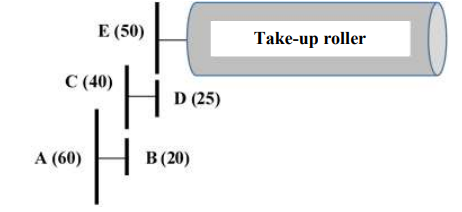
A take-up motion is shown below. The number of teeth on gear A, B, C, D and E are 60, 20, 40, 25 and 50, respectively. The circumference of the take-up roller is 40 cm. If one tooth is broken on gear B, then the wavelength (cm) of the fault in fabric (in integer) is _________________.